I'm taking a little break from the Twins speculation and analysis today to touch on a general baseball news item from the other day. Hope you enjoy this little change of pace. We'll be back to covering everyone's favorite nine tomorrow.
The world, as they say, is becoming smaller and smaller each day. There is no longer such thing as a national economy; there is only the global economy. With improvements in technology, I can now reach Marty in Pakistan as easily as I can Andy across campus.
The sports world also seems to be getting smaller. A large percentage of professional hockey players come from outside the U.S. and Canada. Professional baseball and basketball debut new imports every year, and many of them become stars and flourish. World competition is also at an all-time high. Soccer’s World Cup is one of the most highly anticipated sporting events. Hockey held it’s first-ever World Cup this fall, and the reaction was very positive (it also happened to be the last game that many NHL players will play for a very long time).
These developments have not gone unnoticed at the offices of Major League Baseball. The idea of a baseball World Cup is one that has been tossed around for years, especially by those who doubt the legitimacy of the “World” Series because it does not include the entire world. Yet the concept was always been considered a pipe dream; that is, until last summer. Commissioner Bud Selig revealed that plans were underway to hold a 16-team invitational World Cup tournament in March of 2005. However, the negotiations hit a snafu when some countries (most notably Japan) objected to the fact that the tournament was to be held only in the U.S.
Last week, that roadblock was overcome, as it was decided that one branch of the tournament would be held in Asia, with winners advancing to the finals in the U.S. The late decision also means that March 2006, not next year, will likely be when this project comes to fruition.
Although it may seem a tad premature to look forward with any assurance (especially when the participation of the player’s union and TV networks have yet to be finalized) the possibilities are nothing short of mind-boggling. The United States would probably field the deepest team (Roger Clemens would barely make the squad!) but they would not be the favorites by much.
Sure a lineup consisting of future Hall of Famers Barry Bonds, Alex Rodriguez, Todd Helton, and Gary Sheffield would be imposing (to say the least), but even they would be hard-pressed to score against a Venezuelan team with AL Cy Young award winner Johan Santana and Angels strikeout machine Frankie Rodriguez.
The tiny nations of the Dominican Republic and Puerto Rico (which is technically a U.S. territory, but would be allowed to field its own team) would be more than formidable as well. Imagine Pedro Martinez and his Dominican teammates Albert Pujols, Manny Ramirez, Sammy Sosa, and Vladimir Guerrero squaring off against Carlos Beltran, Ivan Rodriguez, Carlos Delgado and the rest of the Puerto Rican All-Stars. Perennial Olympic gold-medalist Cuba would hold its own, and the Japanese squad would be greatly strengthened from the additions of major league superstars Ichiro Suzuki and Hideki Matsui. Even our neighbors from the north might get into the action with the help of Canadians (and current Minnesota Twins) Corey Koskie and Justin Morneau. The mere possibilities are enough to make any baseball fan salivate in anticipation.
The beauty of a baseball World Cup is that it would have something for everybody. Fans would get to see meaningful competition featuring the world’s best at a time at a time when most people are tired of spring training. The players would have a chance to compete for national pride, an opportunity that Latin American players will especially relish (the Caribbean World Series is already wildly popular event each winter). TV networks and advertisers will have a surefire ratings-topper to fill the “dead time” between the Super Bowl and the NCAA basketball tournament. And major league baseball stands to make a tidy profit, which was obviously the motivation behind the whole tournament all along.
If indeed all this could become a reality, baseball may someday have an event that rivals soccer’s own World Cup in terms of scope and popularity. It does remain to be seen whether multi-million dollar superstars like Bonds could be convinced to participate, or whether owners like George Steinbrenner would allow their highly-paid investments to play, but many people are confident that such hurdles can be overcome.
Nothing is official just yet, but preparations are scheduled to get underway next month with an official announcement coming in the spring. However, one thing is for certain: come March of 2006, the baseball fans from around the globe will be watching.
Tuesday, November 09, 2004


Sunday, November 07, 2004
Checking up on the Fall League
Today we are going to take a quick look at what a few of the Twins prospects are doing in the Arizona Fall League. The league consists of 6 teams, each with a 30 man roster made up of 6 prospects from each team in baseball. It is pretty competitive with many of the best young prospects playing there as a stepping stone to the majors in the coming years. Here are the rules for whom can play, as stated on MLB.com:
All Triple-A and Double-A players are eligible, provided the players are on at least a Double-A level roster no later than Aug. 1.
One player below the Double-A level is allowed per Major League team.
One foreign player is allowed; as long as the player does not reside in a country that participates in winter ball, as part of the Caribbean Confederation or the Australian winter league.
No players with more than one year of credited Major League service as of August 31 are eligible; except a team may select one player picked in the most recently concluded Major League Rule 5 Draft.
To be eligible, players on Minor League disabled lists must be activated at least 45 days before the conclusion of their respective seasons.
The Twins prospects play on the Grand Canyon Rafters, who currently have a record of 12-13. Here are the Twins Hitter's individual stat lines;
Jason Bartlett, SS .333AVG 45AB 10R 3RBI .378SLG .400OBP
Rob Bowen, C .279 AVG 43AB 4R 4RBI .349SLG .367OBP
Kevin West, OF .308AVG 26AB 8R 3RBI .423SLG .333OBP
Comments: Bartlett has also made 3 errors in 11 games, which is probably a little high. It is good to see he is getting on base and scoring runs though. Bowen, also is currently hitting at a higher clip then he showed during his time in both the majors and minors this past season. West replaced Jason Kubel on the roster after Kubel injured his knee. Obviously, it is hard to tell from stats how exactly they are playing but overall these are good numbers to see.
Twins Pitching Stat Lines;
Scott Baker 0-1 3.10 ERA 5G 20.1IP 4BB 19K
Jesse Crain 1-0 2.00ERA 7G 9.0IP 1BB 11K
J.D. Durbin 1-1 4.35ERA 5G 20.2 IP 9BB 26K
Comments: Both Durbin and Baker are in the rotation for the Rafters. The K/BB ratio is pretty good for all three. Durbin has been pretty hard to hit with a .231 opponents batting average. Crain has been better with a .156. Overall the Twins have to be happy with this performance despite a limited sampling. Durbin leads the league in strikeouts with 26. Crain, surprisingly, has yet to record a save.
Other Prospects of Note Playing in the League:
Mark Teahan, Ryan Howard and Rickie Weeks are all in the top 10 in batting. Huston Street leads the league with a .64ERA and 4 saves, Billy Keppinger leads with 4 Wins and Bobby Bradley leads the league with 23.1 innings pitched.
By Comparison;
Players who played in the fall league last year for the Twins included Rob Bowen, Jake Mauer, Terry Tiffee and pitcher Boof Bonser. Tiffee was the only one to make a real impact in the majors last season. In contrast, players like B.J. Upton, Dewon Brazelton, David Wright and Nick Swisher all played in the Arizona Fall League last year and went on to make contributions to their major league teams during the season. Not the most impressive group but proof it is a league made up of future stars.
For a team like the Twins where player development is such a big part of what makes the team successful, the Arizona Fall League is an invaluable place for players to progress. So far the returns this year have been encouraging (if you overlook the early injury to Kubel). Their team is in second place and while the Twins decide who to bring back from last year’s team, players such as Durbin and Baker are playing for the chance to replace them.
John
john.betzler@mnsu.edu
All Triple-A and Double-A players are eligible, provided the players are on at least a Double-A level roster no later than Aug. 1.
One player below the Double-A level is allowed per Major League team.
One foreign player is allowed; as long as the player does not reside in a country that participates in winter ball, as part of the Caribbean Confederation or the Australian winter league.
No players with more than one year of credited Major League service as of August 31 are eligible; except a team may select one player picked in the most recently concluded Major League Rule 5 Draft.
To be eligible, players on Minor League disabled lists must be activated at least 45 days before the conclusion of their respective seasons.
The Twins prospects play on the Grand Canyon Rafters, who currently have a record of 12-13. Here are the Twins Hitter's individual stat lines;
Jason Bartlett, SS .333AVG 45AB 10R 3RBI .378SLG .400OBP
Rob Bowen, C .279 AVG 43AB 4R 4RBI .349SLG .367OBP
Kevin West, OF .308AVG 26AB 8R 3RBI .423SLG .333OBP
Comments: Bartlett has also made 3 errors in 11 games, which is probably a little high. It is good to see he is getting on base and scoring runs though. Bowen, also is currently hitting at a higher clip then he showed during his time in both the majors and minors this past season. West replaced Jason Kubel on the roster after Kubel injured his knee. Obviously, it is hard to tell from stats how exactly they are playing but overall these are good numbers to see.
Twins Pitching Stat Lines;
Scott Baker 0-1 3.10 ERA 5G 20.1IP 4BB 19K
Jesse Crain 1-0 2.00ERA 7G 9.0IP 1BB 11K
J.D. Durbin 1-1 4.35ERA 5G 20.2 IP 9BB 26K
Comments: Both Durbin and Baker are in the rotation for the Rafters. The K/BB ratio is pretty good for all three. Durbin has been pretty hard to hit with a .231 opponents batting average. Crain has been better with a .156. Overall the Twins have to be happy with this performance despite a limited sampling. Durbin leads the league in strikeouts with 26. Crain, surprisingly, has yet to record a save.
Other Prospects of Note Playing in the League:
Mark Teahan, Ryan Howard and Rickie Weeks are all in the top 10 in batting. Huston Street leads the league with a .64ERA and 4 saves, Billy Keppinger leads with 4 Wins and Bobby Bradley leads the league with 23.1 innings pitched.
By Comparison;
Players who played in the fall league last year for the Twins included Rob Bowen, Jake Mauer, Terry Tiffee and pitcher Boof Bonser. Tiffee was the only one to make a real impact in the majors last season. In contrast, players like B.J. Upton, Dewon Brazelton, David Wright and Nick Swisher all played in the Arizona Fall League last year and went on to make contributions to their major league teams during the season. Not the most impressive group but proof it is a league made up of future stars.
For a team like the Twins where player development is such a big part of what makes the team successful, the Arizona Fall League is an invaluable place for players to progress. So far the returns this year have been encouraging (if you overlook the early injury to Kubel). Their team is in second place and while the Twins decide who to bring back from last year’s team, players such as Durbin and Baker are playing for the chance to replace them.
John
john.betzler@mnsu.edu
Tuesday, November 02, 2004
Bringing Back Bradke
It has been widely publicized that the Twins’ number one priority this offseason is resigning free agent Brad Radke. Radke, whose 4-year, $36 million expired after the season, is definitely a key to the Twins’ success next year. While his 11-8 win-loss record may not show it, he was one of the top starting pitchers in the American League this year. His 3.48 ERA that was fourth best in the AL, and his 219 2/3 innings pitched were fifth best in the league.
It’s obvious that the Twins can’t afford to pay him top market value. With the 2005 payroll certain to remain static at $54 million, an annual salary of $9 million for the next three years (which is probably market value) is a lot to ask of a small market team. This is especially true considering that Radke already 32 years old. While there have been some notable exceptions to this recently (Jamie Moyer comes to mind), control pitchers generally begin to lose some effectiveness as they age. Radke is probably past what is commonly defined as a player’s “prime”. That certainly doesn’t mean he washed up—far from it. I don’t think Brad will be sporting a top-5 ERA next year, but I do think he can find a happy medium between his 2003 season (4.49 ERA, 1.27 WHIP) and 2004. I wish the Twins had room to give Radke the 3-year, $27 million deal he probably deserves, but I honestly don’t know if they do. I’m sure Terry Ryan would much rather prefer a 2-year deal worth somewhere in the neighborhood of $14-16 million.
Is Radke willing to accept a slight hometown discount to remain with the only organization he has ever known, the one who he helped lead from the depths of obscurity and futility? The prevailing opinion on that matter has been “yes”, but I’m not so sure. Here are some of the teams that are rumored to be interested in Brad’s services:
Baltimore: Peter Angelos and the Orioles will be spending again this winter (they signed Miguel Tejada, Raphael Palmario, and Javy Lopez last winter), perhaps even more so now that they have to compete for fans with the D.C. Filibusters. They definitely don’t have enough pitching, and if they target Radke (instead of Carl Pavano, Milton, and Matt Morris) they will likely offer him a nice fat contract. Outlook: Baltimore seems like a viable choice for Brad, but I have to think his motivations would have to be almost entirely financial in nature for him to go to such a poorly-run organization.
Boston: The Red Sox are one of the teams that I worry about the most. They’re successful (in case the media has made that clear enough), laid back (again, the media), and most importantly, filthy rich. Plus, they’re likely to lose two of their better starting pitchers (Pedro and Lowe) so there will be a big gap to fill in that rotation. Can Radke resist the temptation to play for the World Champions next year? Outlook: I’d have to say that as it stands now, Boston is the most likely non-Minnesota home for Radke next year. However, I think that Carl Pavano seems like a more reasonable choice for Theo Epstein. Hopefully the Twins can sign Brad soon, before Boston has a chance to target him.
Cleveland: Indians GM Mark Shapiro will allegedly have some cash to spend this winter, and recent articles suggest that he has identified Radke as a possibility. Shapiro needs to keep on dreaming. I can’t envision any circumstances in which Radke would go to Cleveland, unless they made him an absolutely outrageous offer (which they don’t seem to have the finances to do). Outlook: It’s nice that the Indians think they’re going to stock up and make a run on the Twins next year, but I don’t think they’re going to attract any top-tier free agent pitchers, Radke included.
New York: The Yankees are always a possibility when it comes to free agents, and this situation is no different. As much as you might hate them, it’s pretty hard to turn down an extra $5 or $6 million. However, I think Radke knows better in this case. He’s been quoted as saying that he’s not a New York “kind of player”, which is good to hear. At least someone seems willing to acknowledge that the struggles of Jeff Weaver and Javier Vazquez are not flukes. Outlook: While it is still possible that the Yankees land Radke, I would be shocked if they did. I don’t know how well Brad’s low-key demeanor would go over in the Bronx Zoo.
Tampa Bay: There were rumors earlier this year that the hometown Deviled Hams were interested in signing Radke, but those whisperings have been nearly non-existent of late. It seems the Rays have realized (correctly) that they aren’t going to steal any free agents away from the Red Sox or Yankees, let alone the Twins. That being said, Brad would probably like down in southern Florida. There’s no pressure, the weather is nice, he’s near his friends and family, and he can fish whenever he’s not pitching. But still, I don’t know if the Rays are willing to spend the extra money it will take to lure Brad back home. Outlook: Not a chance.
Minnesota: Despite all my ramblings on the contrary, the most likely scenario still has Radke staying in Minnesota. The Twins want him back, Radke has expressed his desire to stay, and there are no hard feelings between the two parties (as opposed to last winter’s Eddie/LaTroy debacle). The only sticking point I can see is money. If Brad decides he wants one last big payday, he’ll probably have to look elsewhere (which would suck for the Twins). However, I don’t think Brad is that type of guy. I’m thinking the Twins give him a near-market value 3-year, 20-24 million dollar deal, probably before Thanksgiving.
I'm want to point out that resigning Radke just isn’t the forgone conclusion that many fans think it will be. If the Twins and Radke can’t get anything done during their window of exclusive negotiations (before Dec. 7), the odds that he’ll be gone are much higher. If the Twins were to lose Radke’s and his 220 innings, they could be in a world of trouble next year.
It’s obvious that the Twins can’t afford to pay him top market value. With the 2005 payroll certain to remain static at $54 million, an annual salary of $9 million for the next three years (which is probably market value) is a lot to ask of a small market team. This is especially true considering that Radke already 32 years old. While there have been some notable exceptions to this recently (Jamie Moyer comes to mind), control pitchers generally begin to lose some effectiveness as they age. Radke is probably past what is commonly defined as a player’s “prime”. That certainly doesn’t mean he washed up—far from it. I don’t think Brad will be sporting a top-5 ERA next year, but I do think he can find a happy medium between his 2003 season (4.49 ERA, 1.27 WHIP) and 2004. I wish the Twins had room to give Radke the 3-year, $27 million deal he probably deserves, but I honestly don’t know if they do. I’m sure Terry Ryan would much rather prefer a 2-year deal worth somewhere in the neighborhood of $14-16 million.
Is Radke willing to accept a slight hometown discount to remain with the only organization he has ever known, the one who he helped lead from the depths of obscurity and futility? The prevailing opinion on that matter has been “yes”, but I’m not so sure. Here are some of the teams that are rumored to be interested in Brad’s services:
Baltimore: Peter Angelos and the Orioles will be spending again this winter (they signed Miguel Tejada, Raphael Palmario, and Javy Lopez last winter), perhaps even more so now that they have to compete for fans with the D.C. Filibusters. They definitely don’t have enough pitching, and if they target Radke (instead of Carl Pavano, Milton, and Matt Morris) they will likely offer him a nice fat contract. Outlook: Baltimore seems like a viable choice for Brad, but I have to think his motivations would have to be almost entirely financial in nature for him to go to such a poorly-run organization.
Boston: The Red Sox are one of the teams that I worry about the most. They’re successful (in case the media has made that clear enough), laid back (again, the media), and most importantly, filthy rich. Plus, they’re likely to lose two of their better starting pitchers (Pedro and Lowe) so there will be a big gap to fill in that rotation. Can Radke resist the temptation to play for the World Champions next year? Outlook: I’d have to say that as it stands now, Boston is the most likely non-Minnesota home for Radke next year. However, I think that Carl Pavano seems like a more reasonable choice for Theo Epstein. Hopefully the Twins can sign Brad soon, before Boston has a chance to target him.
Cleveland: Indians GM Mark Shapiro will allegedly have some cash to spend this winter, and recent articles suggest that he has identified Radke as a possibility. Shapiro needs to keep on dreaming. I can’t envision any circumstances in which Radke would go to Cleveland, unless they made him an absolutely outrageous offer (which they don’t seem to have the finances to do). Outlook: It’s nice that the Indians think they’re going to stock up and make a run on the Twins next year, but I don’t think they’re going to attract any top-tier free agent pitchers, Radke included.
New York: The Yankees are always a possibility when it comes to free agents, and this situation is no different. As much as you might hate them, it’s pretty hard to turn down an extra $5 or $6 million. However, I think Radke knows better in this case. He’s been quoted as saying that he’s not a New York “kind of player”, which is good to hear. At least someone seems willing to acknowledge that the struggles of Jeff Weaver and Javier Vazquez are not flukes. Outlook: While it is still possible that the Yankees land Radke, I would be shocked if they did. I don’t know how well Brad’s low-key demeanor would go over in the Bronx Zoo.
Tampa Bay: There were rumors earlier this year that the hometown Deviled Hams were interested in signing Radke, but those whisperings have been nearly non-existent of late. It seems the Rays have realized (correctly) that they aren’t going to steal any free agents away from the Red Sox or Yankees, let alone the Twins. That being said, Brad would probably like down in southern Florida. There’s no pressure, the weather is nice, he’s near his friends and family, and he can fish whenever he’s not pitching. But still, I don’t know if the Rays are willing to spend the extra money it will take to lure Brad back home. Outlook: Not a chance.
Minnesota: Despite all my ramblings on the contrary, the most likely scenario still has Radke staying in Minnesota. The Twins want him back, Radke has expressed his desire to stay, and there are no hard feelings between the two parties (as opposed to last winter’s Eddie/LaTroy debacle). The only sticking point I can see is money. If Brad decides he wants one last big payday, he’ll probably have to look elsewhere (which would suck for the Twins). However, I don’t think Brad is that type of guy. I’m thinking the Twins give him a near-market value 3-year, 20-24 million dollar deal, probably before Thanksgiving.
I'm want to point out that resigning Radke just isn’t the forgone conclusion that many fans think it will be. If the Twins and Radke can’t get anything done during their window of exclusive negotiations (before Dec. 7), the odds that he’ll be gone are much higher. If the Twins were to lose Radke’s and his 220 innings, they could be in a world of trouble next year.
Sunday, October 31, 2004
Celebrating Halloween
Yesterday was Halloween, a day that means something different for everyone. If you’re ten, it means dressing up and going out to get as much candy as possible for your mom to then take away and ration. If you’re in high school it’s a night to raise a ruckus and run from the law. People my age use it as another excuse to go out in disguise and throw a party. Of course, Latin Americans celebrate Halloween’s religious virtues. If you are the Vikings it is also a day of mourning. Halloween has never really been a baseball holiday, near as I can figure. It usually happens right after the World Series when teams are putting together their off-season plans and players are just beginning to file for free agency. This year, Terry Ryan and the Twins may be getting into the spirit as they monitor a few frightening developments.
Knee Injuries-
Originally I was going to go as an old man for Halloween but when I looked in the mirror I couldn’t help but see the resemblance to two of the Twins most promising young players, Joe Mauer and Jason Kubel. Kubel won’t be back in time to play much of next season but a big fear of Twins fans is that Mauer’s problems will also continue. Another year of putting up with a lineup that is lacking Mauer truly is terrifying.
Pending Free Agents –
I woke up in a cold sweat the other morning thinking about players the Twins might lose in the coming months. A team like the Indians might offer so much money to Brad Radke that the Twins will have to let him go. The market is such that Corey Koskie is a top-three third baseman, making it more difficult to sign him. Cristian Guzman is also a free agent at time when the market is flooded with shortstops but unfortunately there are even more teams looking for one. The biggest horror of free agency might be the guy controlling the pocket book, Dr. Evil (a.k.a. Carl Pohlad).
Kyle Lohse an All-Star –
At first glance this isn’t scary at all. The problem is Lohse will be representing the major league all-stars overseas with a group of other big league players. After the season Lohse just had, his name and the word "all-star" should never be mentioned in the same sentence. I know there is a language barrier but how much can really get lost in translation? The poor people who think they are going to see some good baseball will soon feel like they are stuck in a scary movie. If this is the quality of players major league baseball is exhibiting no wonder the rest of the world wants a World Cup.
What Would Halloween Be Like Without a Trick?
Last week we talked about the Twins bringing back Henry Blanco for another season. This may still be true but Blanco filed for free agency over the weekend. He performed this trick through a clause in his contract allowing him to be a free agent once he reached 280 plate appearances. After Blanco’s performance last year he looks to receive a raise but pity the fool who overpays for his services.
The Best for Last –
A little leftover Halloween treats; Johan Santana should win the American League CY Young in the coming days. Nothing puts a smile on my face like thinking back to the way Johan pitched from June on. As long as he is in the rotation the Twins have a chance every year with a guaranteed win every 5th day.
Now when you start to think of Johan's potential arbitration windfall ($6 million? $7 million? more?), that's the real horror story.
Knee Injuries-
Originally I was going to go as an old man for Halloween but when I looked in the mirror I couldn’t help but see the resemblance to two of the Twins most promising young players, Joe Mauer and Jason Kubel. Kubel won’t be back in time to play much of next season but a big fear of Twins fans is that Mauer’s problems will also continue. Another year of putting up with a lineup that is lacking Mauer truly is terrifying.
Pending Free Agents –
I woke up in a cold sweat the other morning thinking about players the Twins might lose in the coming months. A team like the Indians might offer so much money to Brad Radke that the Twins will have to let him go. The market is such that Corey Koskie is a top-three third baseman, making it more difficult to sign him. Cristian Guzman is also a free agent at time when the market is flooded with shortstops but unfortunately there are even more teams looking for one. The biggest horror of free agency might be the guy controlling the pocket book, Dr. Evil (a.k.a. Carl Pohlad).
Kyle Lohse an All-Star –
At first glance this isn’t scary at all. The problem is Lohse will be representing the major league all-stars overseas with a group of other big league players. After the season Lohse just had, his name and the word "all-star" should never be mentioned in the same sentence. I know there is a language barrier but how much can really get lost in translation? The poor people who think they are going to see some good baseball will soon feel like they are stuck in a scary movie. If this is the quality of players major league baseball is exhibiting no wonder the rest of the world wants a World Cup.
What Would Halloween Be Like Without a Trick?
Last week we talked about the Twins bringing back Henry Blanco for another season. This may still be true but Blanco filed for free agency over the weekend. He performed this trick through a clause in his contract allowing him to be a free agent once he reached 280 plate appearances. After Blanco’s performance last year he looks to receive a raise but pity the fool who overpays for his services.
The Best for Last –
A little leftover Halloween treats; Johan Santana should win the American League CY Young in the coming days. Nothing puts a smile on my face like thinking back to the way Johan pitched from June on. As long as he is in the rotation the Twins have a chance every year with a guaranteed win every 5th day.
Now when you start to think of Johan's potential arbitration windfall ($6 million? $7 million? more?), that's the real horror story.
Friday, October 29, 2004
May I Have Your Attention (Please)
We usually stay away from the controversial world of politics here at Twins Chatter, and for good reason. For some reason, while people will tolerate my thoughts and musings on baseball, they are always perturbed when I (or my fellow baseball bloggers) delve into the realm of politics. I can’t really explain exactly why this is, but I’m willing to accept it. That is, until today.
Today, inspired by Greet Machine’s informative voter’s guide and a recent article in the Strib, I decided I would take a chance. As you all know, election day is next Tuesday. Tensions are running high, as a number of close races (national, statewide, and local) will be decided. There are a great number of issues to be considered—education, Social Security, foreign policy, taxes, abortion—the list goes on and on. But if you’re a Twins fan and a Minnesota resident (sorry out-of-state readers) I would like to remind you of one other issue that you need to consider before you make your choices next week: a potential stadium for our Minnesota Twins.
I know I’m preaching to the choir here, but we all know how desperately the Twins need a new venue. With Olympic Stadium no longer in use, the H.H.H. Metrodome is now undoubtedly the worst ballpark in the major leagues. I know many of us have fond memories of the place; two World Series championships, numerous playoff games, scores of memorable performances. But it is simply a terrible place to watch a baseball game. The sightlines are poor, the lighting is obtrusive, the seats are uncomfortable, and most importantly, it is indoors! And atmosphere? Forget about it. Baseball was meant to be played out-of-doors, and it is a crying shame that an entire generation of Minnesota baseball fans have never seen a game in an actual major league stadium.
The stadium debate has been raging since 1997, and there have been many ups and downs along the way (mostly downs obviously). Below is a brief timeline of the stadium issue in Minnesota, provided by the Minnesota Legislative Reference Library:
1997 - 11 bills are introduced in the Minnesota Legislature regarding a new professional baseball stadium and a special session is called to debate the issue. Nothing passes. Joint bipartisan Stadium Task Force formed.
1998 - Twins owner Carl Pohlad attempts to sell team to North Carolina businessman Don Beaver. Charlotte voters reject a new stadium.
1999 - The legislature proposed to create public ownership of the Twins, but nothing passed. Minneapolis and St. Paul generate competing proposals to build a professional baseball stadium. A St. Paul referendum on the issue fails on November 2, 1999.
2000 - New Ball Park Inc., a group of downtown Minneapolis business leaders, works to find private money to finance a ballpark. Minnesota Twins announce the creation of Minnesotans for Major League Baseball, a citizen committee to address keeping the franchise permanently in Minnesota.
2001 - An 18-member Stadium Task Force prepared recommendations for the 2002 Legislature to address stadium concerns of the Minnesota Twins, Vikings, and the University of Minnesota.
2002 - The existence of the Twins is threatened by Major League Baseball contraction plans. The legislature passes House File 2214, providing state financing for a $330 million stadium in St. Paul. The Twins turn down St. Paul's plan.
2003 - Governor Pawlenty sets up a Stadium Screening Committee to provide information, analysis and advice in making a professional stadium proposal for the 2004 legislative session. The Committee's Final Report published February 4, 2004.
2004 - Stadium bills are introduced, fail to pass
What can one glean from all those “events”? In short, the Twins have spent a whole lot of time and money to accomplish nothing. While there have been periods of hopefulness (last winter comes to mind), the Twins will begin their new stadium campaign pretty much from scratch this year. At least stadium campaigning is now old hat for Jerry Bell and the Twins’ brass.
Obviously, I’m staunchly pro-stadium (which, despite what some naysayers would tell you, doesn’t mean I’m “against the children”). I don’t care how it gets done, I just want my favorite team to have a decent stadium where I can go watch them play. But it’s not that simple for the vast majority of Minnesotans. I recently e-mailed my local state representative Ray Cox (who happens to live just down the street) about this very issue, and here is how he responded:
“Ryan,
Thanks for your message. I suspect the reason you may hear conflicting things on a Twins stadium is because there are several different plans out....some people support one plan, others all plans.
I can support a Twins stadium as long as it does not use any general tax dollars. I don't want to have people in Winona, Warroad, or Mankato pay tax dollars for a Twins stadium if they never go to the stadium. I have no problem with a variety of funding plans such as ticket taxes, tax on sports items, rental cars, etc. to pay for a stadium. I also don't have problems with using some type of tax increment financing to assist a stadium.
Bottom line, as long as the Twins bring in a plan that doesn't consume general tax dollars I will be happy to support it."
Mr. Cox sums the argument up quite well here. I firmly believe this is the way most people feel about this issue, citizens and legislators alike. This begs the question: why hasn’t anything been done? To be honest, it baffles me. I’m tempted to believe the problem lies in our legislative system. Per the nature of American democracy, it is (by design) difficult to get anything done quickly in a legislative branch. Things move so slowly (balancing the budget, funding programs, etc.) that there is often little/no time to discuss more frivolous issues such as a stadium. Thus, even when it is generally agreed upon that something must be done, there isn’t enough time left before the end of the legislative session to approve a viable and acceptable plan. Will 2005 be the year that this changes? Perhaps, but somehow I doubt it.
Please keep in mind that I am not trying to convince you to vote for one candidate over another on Tuesday. I am just trying to bring to your attention this issue, and perhaps shed a little light on it in the process. Perhaps you are on the fence about a certain candidate — e-mail them and ask about their views on the stadium issue. Let your local legislator know that you a constituent who wants something to get done. Make your voice heard both on Tuesday and in the future.
Most importantly, think about watching a Twins game on a warm July evening, as the ball soars beyond the fence and disappears into the beautiful night’s sky.
May that dream some day come true.

Today, inspired by Greet Machine’s informative voter’s guide and a recent article in the Strib, I decided I would take a chance. As you all know, election day is next Tuesday. Tensions are running high, as a number of close races (national, statewide, and local) will be decided. There are a great number of issues to be considered—education, Social Security, foreign policy, taxes, abortion—the list goes on and on. But if you’re a Twins fan and a Minnesota resident (sorry out-of-state readers) I would like to remind you of one other issue that you need to consider before you make your choices next week: a potential stadium for our Minnesota Twins.
I know I’m preaching to the choir here, but we all know how desperately the Twins need a new venue. With Olympic Stadium no longer in use, the H.H.H. Metrodome is now undoubtedly the worst ballpark in the major leagues. I know many of us have fond memories of the place; two World Series championships, numerous playoff games, scores of memorable performances. But it is simply a terrible place to watch a baseball game. The sightlines are poor, the lighting is obtrusive, the seats are uncomfortable, and most importantly, it is indoors! And atmosphere? Forget about it. Baseball was meant to be played out-of-doors, and it is a crying shame that an entire generation of Minnesota baseball fans have never seen a game in an actual major league stadium.
The stadium debate has been raging since 1997, and there have been many ups and downs along the way (mostly downs obviously). Below is a brief timeline of the stadium issue in Minnesota, provided by the Minnesota Legislative Reference Library:
1997 - 11 bills are introduced in the Minnesota Legislature regarding a new professional baseball stadium and a special session is called to debate the issue. Nothing passes. Joint bipartisan Stadium Task Force formed.
1998 - Twins owner Carl Pohlad attempts to sell team to North Carolina businessman Don Beaver. Charlotte voters reject a new stadium.
1999 - The legislature proposed to create public ownership of the Twins, but nothing passed. Minneapolis and St. Paul generate competing proposals to build a professional baseball stadium. A St. Paul referendum on the issue fails on November 2, 1999.
2000 - New Ball Park Inc., a group of downtown Minneapolis business leaders, works to find private money to finance a ballpark. Minnesota Twins announce the creation of Minnesotans for Major League Baseball, a citizen committee to address keeping the franchise permanently in Minnesota.
2001 - An 18-member Stadium Task Force prepared recommendations for the 2002 Legislature to address stadium concerns of the Minnesota Twins, Vikings, and the University of Minnesota.
2002 - The existence of the Twins is threatened by Major League Baseball contraction plans. The legislature passes House File 2214, providing state financing for a $330 million stadium in St. Paul. The Twins turn down St. Paul's plan.
2003 - Governor Pawlenty sets up a Stadium Screening Committee to provide information, analysis and advice in making a professional stadium proposal for the 2004 legislative session. The Committee's Final Report published February 4, 2004.
2004 - Stadium bills are introduced, fail to pass
What can one glean from all those “events”? In short, the Twins have spent a whole lot of time and money to accomplish nothing. While there have been periods of hopefulness (last winter comes to mind), the Twins will begin their new stadium campaign pretty much from scratch this year. At least stadium campaigning is now old hat for Jerry Bell and the Twins’ brass.
Obviously, I’m staunchly pro-stadium (which, despite what some naysayers would tell you, doesn’t mean I’m “against the children”). I don’t care how it gets done, I just want my favorite team to have a decent stadium where I can go watch them play. But it’s not that simple for the vast majority of Minnesotans. I recently e-mailed my local state representative Ray Cox (who happens to live just down the street) about this very issue, and here is how he responded:
“Ryan,
Thanks for your message. I suspect the reason you may hear conflicting things on a Twins stadium is because there are several different plans out....some people support one plan, others all plans.
I can support a Twins stadium as long as it does not use any general tax dollars. I don't want to have people in Winona, Warroad, or Mankato pay tax dollars for a Twins stadium if they never go to the stadium. I have no problem with a variety of funding plans such as ticket taxes, tax on sports items, rental cars, etc. to pay for a stadium. I also don't have problems with using some type of tax increment financing to assist a stadium.
Bottom line, as long as the Twins bring in a plan that doesn't consume general tax dollars I will be happy to support it."
Mr. Cox sums the argument up quite well here. I firmly believe this is the way most people feel about this issue, citizens and legislators alike. This begs the question: why hasn’t anything been done? To be honest, it baffles me. I’m tempted to believe the problem lies in our legislative system. Per the nature of American democracy, it is (by design) difficult to get anything done quickly in a legislative branch. Things move so slowly (balancing the budget, funding programs, etc.) that there is often little/no time to discuss more frivolous issues such as a stadium. Thus, even when it is generally agreed upon that something must be done, there isn’t enough time left before the end of the legislative session to approve a viable and acceptable plan. Will 2005 be the year that this changes? Perhaps, but somehow I doubt it.
Please keep in mind that I am not trying to convince you to vote for one candidate over another on Tuesday. I am just trying to bring to your attention this issue, and perhaps shed a little light on it in the process. Perhaps you are on the fence about a certain candidate — e-mail them and ask about their views on the stadium issue. Let your local legislator know that you a constituent who wants something to get done. Make your voice heard both on Tuesday and in the future.
Most importantly, think about watching a Twins game on a warm July evening, as the ball soars beyond the fence and disappears into the beautiful night’s sky.
May that dream some day come true.
Thursday, October 28, 2004
A Historic Night
Some of you may have noticed that you can now access Twins Chatter directly simply by typing in www.twinschatter.com. For now you will see an annoying banner at the bottom of the page, so don't go changing your links just yet. When the new site is up and running that will go away. This kicks off some of the changes we will be making throughout the course of the winter to make Twins Chatter that much better. As always we thank you for your support in what continues to be a great experience.
Where were you when the Red Sox finally won the World Series? Unless you are older than 87 you could not have answered this question yesterday because the Red Sox had not won a championship in your lifetime. I am only 20 years old and I’ll be the first to admit I lack the perspective of time. You don’t even have to be a baseball fan though to realize how special this is for the sport and its fans. The way the Red Sox won was so improbable and even magical, that they not only escaped the curse, they trampled on it.
This was a team that overcame a 3 game deficit to their hated rival, the New York Yankees. In doing so, they may have ushered in a new era of baseball history. Only time will tell if it’s now the Yankees turn to wait nearly 90 years for their next title. They will have at least an off-season to ponder what might have been, left with the belief that it should have been them playing late into October. The Yankees had cheated baseball one too many times and eventually, it all catches up to a team with no starting pitching.
The Red Sox pitching staff was anchored by a legend pitching with one good ankle in a position that depends so much on the legs. Every pitch could have been Schilling’s last, and yet he kept throwing just well enough for his team to win, bloody sock and all. The other star pitcher overcame his own demons to beat the Yankees; then came back and pitched one of his best games in what could have been his last in a Red Sox uniform. Pedro may have looked like his 1999 self, but Derek Lowe looked like he was a different pitcher. After almost being traded at the deadline and struggling through the entire regular season, the guy who wasn’t even supposed to be in the rotation won all three deciding games, the last two by dominating. Lowe was masterful and Keith Foulke shut the door. Foulke is another enigma; a closer who doesn’t throw hard but just gets hitters out.
The World Series MVP was offered to every other team in baseball last off-season for nothing in return, and no one wanted him. He was almost traded for the best player in baseball before that deal fell through 3 different times. At times, he looked more like a boy than a man out there and yet he came through in the clutch. Their other playoff MVP was discarded by a team that hasn’t had someone hit 30 homeruns since 1987. He might end up being the MVP of the regular season, where he slugged over 40. These days David has become goliath and that big smile on his face isn’t just because he has peanut butter in his underwear.
Doug Mientkiewicz gets the last laugh over the Twins. He went from batting third on a team 3 games away from the World Series to being a small piece on a team where he is going to get a ring. He also had the privilege of catching the important last outs of games and thus being the first player to jump in celebration. Doug remains the biggest paradox of all, a first baseman that can’t hit and wont shut up despite it.
The list goes on and on. Their second baseman had been discarded by several teams and went from a goat to hero; the 3rd baseman went from being a guy who couldn’t hit to a batting champ. One of their best hitters should by all rights be playing in Japan right now. Their best player of the last decade was traded at the deadline. Their bullpen was anchored by a guy who has jumped around half a dozen teams in baseball already and another who was around for the Blue Jays dynasty of the early 90’s. Their shortstop came from a team without a home, owner or payroll. The one thing they had going for them was Jesus playing centerfield and it even took him a few games to figure out how to hit. The Red Sox won despite it all or maybe because of it. Instead of a compilation of separate pieces they were a team that played together and off each other.
Every year the team that wins the World Series creates the new formula for success. This year that formula cannot be copied. Yes, they have the 2nd highest payroll in baseball but throwing money at players does not often equal success; just ask the Dodgers and now the Yankees. Their general manager is a disciple of the Moneyball philosophy and also happens to look like a guy in my freshman English class. He was smart enough to bring in the right parts and had the good fortune of getting a little lucky on the way. He was also flexible enough to adjust at midseason and fix a defense that never would have allowed the Sox to get this far.
It is impossible for me to describe what a Red Sox World Series win means. I don’t possess the words and it would not do justice to all their fans who have waited so long. All I can do is congratulate them for doing something so many other good teams could not. They made history last night and all through the postseason. They alone deserve credit for this triumph over both the Evil Empire and fate. On a night where there was a full lunar eclipse, everything was aligned to create baseball immortality out of a rag-tag bunch that wasn’t supposed to be there.
-John Betzler
On a completely unrelated note, I strongly invite all Minnesota residents to check out this extremely helpful stadium voting guide, brought to you by Shane over at Greet Machine. If you're a Twins fan, and you want to see a stadium built someday, do your part next Tuesday. I'll have a post dealing with this topic later this week, probably tomorrow. If you haven't made up your mind yet as to who you're voting for, perhaps this guide will help you make your decision. Check out Twins Chatter for more in the days ahead.
*by Ryan*
Where were you when the Red Sox finally won the World Series? Unless you are older than 87 you could not have answered this question yesterday because the Red Sox had not won a championship in your lifetime. I am only 20 years old and I’ll be the first to admit I lack the perspective of time. You don’t even have to be a baseball fan though to realize how special this is for the sport and its fans. The way the Red Sox won was so improbable and even magical, that they not only escaped the curse, they trampled on it.
This was a team that overcame a 3 game deficit to their hated rival, the New York Yankees. In doing so, they may have ushered in a new era of baseball history. Only time will tell if it’s now the Yankees turn to wait nearly 90 years for their next title. They will have at least an off-season to ponder what might have been, left with the belief that it should have been them playing late into October. The Yankees had cheated baseball one too many times and eventually, it all catches up to a team with no starting pitching.
The Red Sox pitching staff was anchored by a legend pitching with one good ankle in a position that depends so much on the legs. Every pitch could have been Schilling’s last, and yet he kept throwing just well enough for his team to win, bloody sock and all. The other star pitcher overcame his own demons to beat the Yankees; then came back and pitched one of his best games in what could have been his last in a Red Sox uniform. Pedro may have looked like his 1999 self, but Derek Lowe looked like he was a different pitcher. After almost being traded at the deadline and struggling through the entire regular season, the guy who wasn’t even supposed to be in the rotation won all three deciding games, the last two by dominating. Lowe was masterful and Keith Foulke shut the door. Foulke is another enigma; a closer who doesn’t throw hard but just gets hitters out.
The World Series MVP was offered to every other team in baseball last off-season for nothing in return, and no one wanted him. He was almost traded for the best player in baseball before that deal fell through 3 different times. At times, he looked more like a boy than a man out there and yet he came through in the clutch. Their other playoff MVP was discarded by a team that hasn’t had someone hit 30 homeruns since 1987. He might end up being the MVP of the regular season, where he slugged over 40. These days David has become goliath and that big smile on his face isn’t just because he has peanut butter in his underwear.
Doug Mientkiewicz gets the last laugh over the Twins. He went from batting third on a team 3 games away from the World Series to being a small piece on a team where he is going to get a ring. He also had the privilege of catching the important last outs of games and thus being the first player to jump in celebration. Doug remains the biggest paradox of all, a first baseman that can’t hit and wont shut up despite it.
The list goes on and on. Their second baseman had been discarded by several teams and went from a goat to hero; the 3rd baseman went from being a guy who couldn’t hit to a batting champ. One of their best hitters should by all rights be playing in Japan right now. Their best player of the last decade was traded at the deadline. Their bullpen was anchored by a guy who has jumped around half a dozen teams in baseball already and another who was around for the Blue Jays dynasty of the early 90’s. Their shortstop came from a team without a home, owner or payroll. The one thing they had going for them was Jesus playing centerfield and it even took him a few games to figure out how to hit. The Red Sox won despite it all or maybe because of it. Instead of a compilation of separate pieces they were a team that played together and off each other.
Every year the team that wins the World Series creates the new formula for success. This year that formula cannot be copied. Yes, they have the 2nd highest payroll in baseball but throwing money at players does not often equal success; just ask the Dodgers and now the Yankees. Their general manager is a disciple of the Moneyball philosophy and also happens to look like a guy in my freshman English class. He was smart enough to bring in the right parts and had the good fortune of getting a little lucky on the way. He was also flexible enough to adjust at midseason and fix a defense that never would have allowed the Sox to get this far.
It is impossible for me to describe what a Red Sox World Series win means. I don’t possess the words and it would not do justice to all their fans who have waited so long. All I can do is congratulate them for doing something so many other good teams could not. They made history last night and all through the postseason. They alone deserve credit for this triumph over both the Evil Empire and fate. On a night where there was a full lunar eclipse, everything was aligned to create baseball immortality out of a rag-tag bunch that wasn’t supposed to be there.
-John Betzler
On a completely unrelated note, I strongly invite all Minnesota residents to check out this extremely helpful stadium voting guide, brought to you by Shane over at Greet Machine. If you're a Twins fan, and you want to see a stadium built someday, do your part next Tuesday. I'll have a post dealing with this topic later this week, probably tomorrow. If you haven't made up your mind yet as to who you're voting for, perhaps this guide will help you make your decision. Check out Twins Chatter for more in the days ahead.
*by Ryan*
Tuesday, October 26, 2004
The Waves Theory
As the enormity of Jason Kubel’s injury began to set in yesterday, I got to thinking about the Twins minor league organization. As the Twins Geek so eloquently stated yesterday, the Twins (and their fans) depend on their minor league teams more than any other franchise. Without Terry Ryan and his stable of talented scouts, the Minnesota Twins would be, well, the Milwaukee Brewers. With a crappier stadium.
However, for a team like the Twins, simply developing major-league ready talent isn’t good enough if you want to compete for a championship. When you have to fill out 80% (or more) of your roster with homegrown players, you need many of those players to be ready at approximately the same time. Thus, I have developed the “Waves Theory”. While this theory is admittedly rudimentary, I believe it does have some merit.
By now, nearly everyone is familiar with the first “wave” of the post-Dark Years era (’93-’00) Minnesota Twins. Torii Hunter, Jacque Jones, Doug Mientkiewicz, Corey Koskie, Christian Guzman, Eric Milton, Kyle Lohse, Luis Rivas, A.J. Pierzynski, David Ortiz, Johan Santana, even LaTroy Hawkins and J.C. Romero to an extent — these guys were the “Turnaround Twins”. Combined with some of the pieces already in place (Radke, Guardado) and an acquisition or two (Reed, Rogers, Stewart) this core group struggled for three years together finally turning it around in 2001. They were given the opportunity to learn and develop in the big leagues, and delivered. You all know the story, I’m sure.
Yet the First Wave™ is slowly fragmenting. Such is the reality for a small-market franchise. Ortiz was let go (prematurely, it seems), Milty, A.J., and Dougie were traded, and LaTroy and Eddie decided to leave. J.J. is all but gone (for real, this time), as are J.C. and Rivas (there probably wont be any tears shed there). There is a chance that Guzy, Koskie, and Bradke won’t be back, although there is a distinct possibility that at least two of the three will return.
In a perfect world (read: Cleveland in the mid-‘90s) the Twins would have a new stadium and plenty of money to keep all these guys around forever. But this is not the case. In order to survive, small-market teams must pick and choose from that first wave the core players they wish to retain and then fill in the rest with subsequent waves. The Twins are now in the process of doing this. Torii has been already been chosen as a core player; Koskie and Radke will probably be next.
That wave is in the past. But who comprises the next waves of talent for the Twins, the guys who will (hopefully) get us over the proverbial hump? I’m glad you asked.
The Second Wave™
This group of players is not as easily definable as the original core was, but they are just as important to the future of this franchise. Most of these guys weren’t considered “plucky” or “longshots” as that ’98 group was; they are immensely talented and are expected to succeed. Some are already in the majors and contributing, while the others will probably do so in 2005.
Joe Mauer: Though he was only drafted three years ago, the Twins are counting on Mauer to be their cornerstone player well into the future. Mauer is the most talented player on this team, and if his one-and-a-half month big league stint is any indication, he will begin fulfilling his promise next year. Assuming he’s healthy (please, baseball gods, don’t let us down).
Justin Morneau: Morneau is just as important as Mauer when it comes to the future success of this team. If he can continue to improve, the Twins may have their first legitimate power threat since Harmon Killebrew.
Lew Ford: Ford doesn’t fit in here quite as well, considering he’s as old as the first group, but he wasn’t given a chance to prove himself until this past season. A successful club needs players like Ford: steady, high OBP, average power, with good defense. Hopefully Sweet Lew will be around for a long time.
Michael Cuddyer: Cuddyer may be a little older than Morneau and Mauer (he’ll turn 26 next March) yet he still fits in with this wave. The Twins will rely heavily on Cuddyer in 2005 and beyond, and I think he’ll provide consistent production wherever he plays.
Jesse Crain: Reliever prospects like Crain are a rare breed, but the Twins are fortunate enough to have one of the best at their disposal. He was impressive this past August and September, and will undoubtedly become a key cog in the 2005 Twins’ bullpen.
Jason Kubel: I almost didn’t include Kubel, as his once-promising future is now in serious doubt. Now it appears the earliest Kubel will contribute is 2006, if even then. Just a terrible break for both Kubel and this organization.
J.D. Durbin: The “Real Deal” better be ready to step it up in ’05, as his team is going to need him. Durbin’s combination of self-confidence and 95 mph heat should serve him well in the near future, assuming he can fine-tune his location a bit.
Scott Baker: Baker isn’t the can’t-miss talent that Durbin is, but he too could play a role in 2005. The 2003 second-round pick was terrific in A and AA (2.42 ERA in 115 1/3 innings) but was hit around a bit at AAA. He’s a very polished control-type pitcher who may soon be a good #3 or 4 starter.
Jason Bartlett: I know Bartlett didn’t look very impressive in his short stint with the Twins this year, but he’s still one of the better middle infield prospects in the game. Ranked the 10th best International League (AAA) prospect recently by Baseball America, Bartlett could take over at shortstop as early as next year.
Fringe Members: Terry Tiffee, Boof Bonser
The Future Wave™
I know it seems blasphemous to even mention, but someday even the first and second waves won’t be enough to compete in the ever-improving AL Central. That’s where the Future Wave comes in. Most of these guys are far too young for us to predict their futures with any certainty, but speculation is just so dang fun that I can’t help myself. While the second wave is chockfull of position players, the future (or third) wave is pitching-heavy. The 2004 draft windfall is the key component of this next group.
Francisco Liriano: Liriano, a hard-throwing lefthanded pitcher who actually turns 21 today (Happy Birthday!), was acquired in the Pierzynski-Nathan trade last winter. If he can fight off the health problems that plagued him with the Giants, he could become a very successful major league pitcher. Liriano had a pretty good year between A and AA, averaging about 10 K/9 innings pitched.
Kyle Waldrop: When the Twins took the relatively unknown Waldrop with the 25th overall pick in this year’s draft, many people outside the organization were perplexed. However, it appears that Terry Ryan and his group of geniuses have struck gold again. Waldrop, who is only 18 years old, had a terrific season between the GCL Twins and Elizabethton. Baseball American ranked him as one of the best prospects in both leagues, and he’s described as the rare 18-year-old who “knows how to pitch”. If you’ve ever spent any time watching or playing with high school or college pitchers, you can appreciate just how unique this kid is.
Trevor Ploufee: Ploufee was another 2004 draftee, one of the only position players the Twins took (he’s a shortstop). He had a pretty good season at rookie ball, hitting .283 with a .340 OBP. His defense also impressed, which allowed him to make BA’s top Appalachian League prospects list. Ploufee’s probably already the organization’s second-best middle infield prospect (which isn’t saying a whole lot) and will hopefully rise rapidly through the organization.
Other Potential Future Stars:
Adam Harben: This young RHP is a work in progress. He throws hard and had a good season at Quad Cities last year (3.09 ERA in 143 IP).
Alexander Smit: Smit, a product of the Netherlands, is a talented young lefty at the rookie level. He simply needs time to develop.
Glen Perkins: This U of M product has great stuff and is very polished. He should climb the organizational ladder quickly.
Matt Moses: Moses was the team’s first-round draft choice in 2003, but the third basemen has struggled mightily with injuries and/or sickness.
Jay Rainville: A personal favorite of mine, Rainville (a supplemental pick last year) pitched well in the GCL last year.
There you have it. I know this was a rather rudimentary look at the Twins’ top prospects (it isn’t meant to be a “top ten” list or anything). There are players who don’t really fit into any particular wave of players (Juan Rincon comes to mind) so not everyone can be included. However, I think this is a fun way to look at the method in which the Twins have produced (and are in the midst of producing) major league talent over the past few years.
As you can see, after the upcoming group (Mauer, Morneau, Durbin, etc.) goes through, the cabinet is a little bare. The Twins don’t really have any standout prospects at the AA or high-A levels, and the future wave of pitchers probably won’t be ready until 2007 or 2008 (possibly even ’09). TR and the boys will have to stock the cupboard with shrewd trades (JJ perhaps?) in order to give the organization a little more depth. However, the Twins still run arguably the best organization in the major leagues, and have for quite some time. While other small-market teams like Pittsburgh and Kansas City bemoan their lack of major-league ready talent, the Twins are sitting pretty. In the AL Central, that could mean a run of success unprecedented in team history.
As always, if you feel I’ve neglected to mention something or feel the need to comment on the above topics, I encourage you to drop a comment below. John and I always enjoy responding to these, and they often serve as inspiration for future posts.
-Ryan M.
However, for a team like the Twins, simply developing major-league ready talent isn’t good enough if you want to compete for a championship. When you have to fill out 80% (or more) of your roster with homegrown players, you need many of those players to be ready at approximately the same time. Thus, I have developed the “Waves Theory”. While this theory is admittedly rudimentary, I believe it does have some merit.
By now, nearly everyone is familiar with the first “wave” of the post-Dark Years era (’93-’00) Minnesota Twins. Torii Hunter, Jacque Jones, Doug Mientkiewicz, Corey Koskie, Christian Guzman, Eric Milton, Kyle Lohse, Luis Rivas, A.J. Pierzynski, David Ortiz, Johan Santana, even LaTroy Hawkins and J.C. Romero to an extent — these guys were the “Turnaround Twins”. Combined with some of the pieces already in place (Radke, Guardado) and an acquisition or two (Reed, Rogers, Stewart) this core group struggled for three years together finally turning it around in 2001. They were given the opportunity to learn and develop in the big leagues, and delivered. You all know the story, I’m sure.
Yet the First Wave™ is slowly fragmenting. Such is the reality for a small-market franchise. Ortiz was let go (prematurely, it seems), Milty, A.J., and Dougie were traded, and LaTroy and Eddie decided to leave. J.J. is all but gone (for real, this time), as are J.C. and Rivas (there probably wont be any tears shed there). There is a chance that Guzy, Koskie, and Bradke won’t be back, although there is a distinct possibility that at least two of the three will return.
In a perfect world (read: Cleveland in the mid-‘90s) the Twins would have a new stadium and plenty of money to keep all these guys around forever. But this is not the case. In order to survive, small-market teams must pick and choose from that first wave the core players they wish to retain and then fill in the rest with subsequent waves. The Twins are now in the process of doing this. Torii has been already been chosen as a core player; Koskie and Radke will probably be next.
That wave is in the past. But who comprises the next waves of talent for the Twins, the guys who will (hopefully) get us over the proverbial hump? I’m glad you asked.
The Second Wave™
This group of players is not as easily definable as the original core was, but they are just as important to the future of this franchise. Most of these guys weren’t considered “plucky” or “longshots” as that ’98 group was; they are immensely talented and are expected to succeed. Some are already in the majors and contributing, while the others will probably do so in 2005.
Joe Mauer: Though he was only drafted three years ago, the Twins are counting on Mauer to be their cornerstone player well into the future. Mauer is the most talented player on this team, and if his one-and-a-half month big league stint is any indication, he will begin fulfilling his promise next year. Assuming he’s healthy (please, baseball gods, don’t let us down).
Justin Morneau: Morneau is just as important as Mauer when it comes to the future success of this team. If he can continue to improve, the Twins may have their first legitimate power threat since Harmon Killebrew.
Lew Ford: Ford doesn’t fit in here quite as well, considering he’s as old as the first group, but he wasn’t given a chance to prove himself until this past season. A successful club needs players like Ford: steady, high OBP, average power, with good defense. Hopefully Sweet Lew will be around for a long time.
Michael Cuddyer: Cuddyer may be a little older than Morneau and Mauer (he’ll turn 26 next March) yet he still fits in with this wave. The Twins will rely heavily on Cuddyer in 2005 and beyond, and I think he’ll provide consistent production wherever he plays.
Jesse Crain: Reliever prospects like Crain are a rare breed, but the Twins are fortunate enough to have one of the best at their disposal. He was impressive this past August and September, and will undoubtedly become a key cog in the 2005 Twins’ bullpen.
Jason Kubel: I almost didn’t include Kubel, as his once-promising future is now in serious doubt. Now it appears the earliest Kubel will contribute is 2006, if even then. Just a terrible break for both Kubel and this organization.
J.D. Durbin: The “Real Deal” better be ready to step it up in ’05, as his team is going to need him. Durbin’s combination of self-confidence and 95 mph heat should serve him well in the near future, assuming he can fine-tune his location a bit.
Scott Baker: Baker isn’t the can’t-miss talent that Durbin is, but he too could play a role in 2005. The 2003 second-round pick was terrific in A and AA (2.42 ERA in 115 1/3 innings) but was hit around a bit at AAA. He’s a very polished control-type pitcher who may soon be a good #3 or 4 starter.
Jason Bartlett: I know Bartlett didn’t look very impressive in his short stint with the Twins this year, but he’s still one of the better middle infield prospects in the game. Ranked the 10th best International League (AAA) prospect recently by Baseball America, Bartlett could take over at shortstop as early as next year.
Fringe Members: Terry Tiffee, Boof Bonser
The Future Wave™
I know it seems blasphemous to even mention, but someday even the first and second waves won’t be enough to compete in the ever-improving AL Central. That’s where the Future Wave comes in. Most of these guys are far too young for us to predict their futures with any certainty, but speculation is just so dang fun that I can’t help myself. While the second wave is chockfull of position players, the future (or third) wave is pitching-heavy. The 2004 draft windfall is the key component of this next group.
Francisco Liriano: Liriano, a hard-throwing lefthanded pitcher who actually turns 21 today (Happy Birthday!), was acquired in the Pierzynski-Nathan trade last winter. If he can fight off the health problems that plagued him with the Giants, he could become a very successful major league pitcher. Liriano had a pretty good year between A and AA, averaging about 10 K/9 innings pitched.
Kyle Waldrop: When the Twins took the relatively unknown Waldrop with the 25th overall pick in this year’s draft, many people outside the organization were perplexed. However, it appears that Terry Ryan and his group of geniuses have struck gold again. Waldrop, who is only 18 years old, had a terrific season between the GCL Twins and Elizabethton. Baseball American ranked him as one of the best prospects in both leagues, and he’s described as the rare 18-year-old who “knows how to pitch”. If you’ve ever spent any time watching or playing with high school or college pitchers, you can appreciate just how unique this kid is.
Trevor Ploufee: Ploufee was another 2004 draftee, one of the only position players the Twins took (he’s a shortstop). He had a pretty good season at rookie ball, hitting .283 with a .340 OBP. His defense also impressed, which allowed him to make BA’s top Appalachian League prospects list. Ploufee’s probably already the organization’s second-best middle infield prospect (which isn’t saying a whole lot) and will hopefully rise rapidly through the organization.
Other Potential Future Stars:
Adam Harben: This young RHP is a work in progress. He throws hard and had a good season at Quad Cities last year (3.09 ERA in 143 IP).
Alexander Smit: Smit, a product of the Netherlands, is a talented young lefty at the rookie level. He simply needs time to develop.
Glen Perkins: This U of M product has great stuff and is very polished. He should climb the organizational ladder quickly.
Matt Moses: Moses was the team’s first-round draft choice in 2003, but the third basemen has struggled mightily with injuries and/or sickness.
Jay Rainville: A personal favorite of mine, Rainville (a supplemental pick last year) pitched well in the GCL last year.
There you have it. I know this was a rather rudimentary look at the Twins’ top prospects (it isn’t meant to be a “top ten” list or anything). There are players who don’t really fit into any particular wave of players (Juan Rincon comes to mind) so not everyone can be included. However, I think this is a fun way to look at the method in which the Twins have produced (and are in the midst of producing) major league talent over the past few years.
As you can see, after the upcoming group (Mauer, Morneau, Durbin, etc.) goes through, the cabinet is a little bare. The Twins don’t really have any standout prospects at the AA or high-A levels, and the future wave of pitchers probably won’t be ready until 2007 or 2008 (possibly even ’09). TR and the boys will have to stock the cupboard with shrewd trades (JJ perhaps?) in order to give the organization a little more depth. However, the Twins still run arguably the best organization in the major leagues, and have for quite some time. While other small-market teams like Pittsburgh and Kansas City bemoan their lack of major-league ready talent, the Twins are sitting pretty. In the AL Central, that could mean a run of success unprecedented in team history.
As always, if you feel I’ve neglected to mention something or feel the need to comment on the above topics, I encourage you to drop a comment below. John and I always enjoy responding to these, and they often serve as inspiration for future posts.
-Ryan M.
Sunday, October 24, 2004
Winter Claims Its First Victim
There is a good chance the Twins have done something to anger the baseball gods. Maybe it had something to do with leaving Joe Nathan in an inning too long. Perhaps it goes back to the day David Ortiz walked out the door forever. In less than a year the Twins have lost two young phenom players to a knee injury. Just over a week ago, I wrote in this space about how important it was for the Twins to get healthy during the off-season, after having several key players miss significant time this year. In the same post we also talked about how important the development of some key young players would be to next year’s success. Jason Kubel was one of those key players taking part in the Arizona fall league until he had the misfortune of getting hurt. In the big picture this will not have the same devastating effect as Joe Mauer’s nagging knee injury last year. The team will have time to adjust some of its plans while Kubel is out up to 6 months.
If the Twins need to trade Jones, and Kubel is unavailable, they have other options for right field. Lew Ford, who batted .299 with 15 homers and 72 RBI in his first full season of action, could move to the outfield. Rochester native Michael Restovich, who spent most of the season in the minors, could get his long-awaited break. And one Twins official pointed out that Michael Cuddyer, mentioned as a possible replacement for free agent Corey Koskie at third or for underperforming Luis Rivas at second, could play right field. - Star Tribune
The one spot the Twins have the most organizational depth is outfield. Kubel was a pleasant surprise this past year and made himself a part of the team’s 2005 plans. If you had asked someone at the beginning of the 2004 season what the lineup would look like in one year, few would have automatically penciled Kubel in. They would have thrown out names like LeCroy and Restovich. Before hurting himself, Kubel was still not assured the starting job. The players who will replace him are players he would have battled in spring training.
This was supposed to be the year that Matt LeCroy finally got a fulltime chance to prove himself. 264 at-bats later, LeCroy is another year older and in the same spot. He is a solid fill-in until Kubel comes back or someone else emerges to take his spot. What he proved last year is that he is not going to light the world on fire but he can step in anywhere in the lineup with steady production.
Restovich is another option. Just two seasons ago he was another phenom prospect just waiting for the call. He received that call but was not given a full time opportunity to take advantage of it. Instead he played scared, tried too hard to cut down on his strikeouts and has not been a prospect since. His swing may be too long for the big show and he has yet to realize the power output, even at the minor league level, that was hoped for. Next year he will be out of options and Kubel going down may be the break he needs. At this point he has looked too much like Brian Buchanan with a little more speed to warrant much optimism.
It is intriguing that Michael Cuddyer was mentioned as a replacement. He has been slated for some time as an infield replacement either at 2nd or 3rd and proved himself with his late season production. I have not been a believer that he would replace Koskie, since Cuddyer seems uncomfortable at third and it makes more since to either bring back Koskie or let Terry Tiffee have a chance there. If Cuddyer were to move to right it would mean the Twins are willing to go to arbitration with Luis Rivas and pay him for the additional defense at second base. Rivas turns a much better double play then Cuddyer but is not that much better at anything else. Cuddyer even looked much improved defensively as the season came to a close. Nick Punto is another option at second but that would mean the team would bring back Cristian Guzman or a replacement at short. The money spent to keep Rivas would be better spent on Koskie or a cheap outfielder that is going to hit better than Rivas. It might even be a possibility to apply that money to bring back Jacque Jones.
All along it has been assumed the Twins would not be bringing back Jacque Jones with his escalating price tag and their glut of outfielders in the system. The organization has never come straight out and said that Jones would not be back thus leaving open the possibility. If they are not able to deal Jones, he could be back in right next year. I still don’t think it is likely. Jones is going to be overpaid if the team goes to arbitration with him. There are better options out there. He is a player with no real spot on the team anymore. He is not an ideal 2nd hitter where he ended the season, his batting average was down this year at .254 and he is a corner outfielder who only hit 24 homeruns. The only way he will be in a Twins uniform next year is if he signs a deal at a reduced rate and even so, the team would be crazy if it was for more then 1 year. The Kubel injury does make his return more plausible though.
At this point, it is hard to speculate about which free agents will be available in the Twins price range. It is highly unlikely the Twins would go that route either. In the past, they have either gone in-house or made a trade to fill most of their needs. A trade is still a possibility, especially when it comes to Jones or an enigma like JC Romero, but don’t expect Ryan to equal his success from last year. I hope they don’t settle on a player they know like Jones, who has already shown his limited upside. The Twins should at least consider looking for a player capable of more production. Those players are hard to come by and usually carry baggage though so it might be best for the team to let Jones go and replace him with what they already have.
The Kubel injury does nothing but muddle the big picture. Before it was a matter of which of the big three free agents would be resigned. If the team failed to bring back Guzman or Koskie, it was possible a similar free agent would replace them. By bringing back Guzman or signing another shortstop the team could non-tender Rivas and have the depth to replace him with Michael Cuddyer and Nick Punto. That is probably the most likely scenario but because Cuddyer can play so many positions it makes it harder to predict. The team’s payroll will not go up and so if money is used to replace Kubel, it will have to come from somewhere else. It is hard to fathom bringing back Jacque Jones but it could happen. When Mauer went down during the season, the team had no replacement ready to pick up the slack. Kubel’s injury coming so early, allows them the chance to try to replace his production.
If the Twins need to trade Jones, and Kubel is unavailable, they have other options for right field. Lew Ford, who batted .299 with 15 homers and 72 RBI in his first full season of action, could move to the outfield. Rochester native Michael Restovich, who spent most of the season in the minors, could get his long-awaited break. And one Twins official pointed out that Michael Cuddyer, mentioned as a possible replacement for free agent Corey Koskie at third or for underperforming Luis Rivas at second, could play right field. - Star Tribune
The one spot the Twins have the most organizational depth is outfield. Kubel was a pleasant surprise this past year and made himself a part of the team’s 2005 plans. If you had asked someone at the beginning of the 2004 season what the lineup would look like in one year, few would have automatically penciled Kubel in. They would have thrown out names like LeCroy and Restovich. Before hurting himself, Kubel was still not assured the starting job. The players who will replace him are players he would have battled in spring training.
This was supposed to be the year that Matt LeCroy finally got a fulltime chance to prove himself. 264 at-bats later, LeCroy is another year older and in the same spot. He is a solid fill-in until Kubel comes back or someone else emerges to take his spot. What he proved last year is that he is not going to light the world on fire but he can step in anywhere in the lineup with steady production.
Restovich is another option. Just two seasons ago he was another phenom prospect just waiting for the call. He received that call but was not given a full time opportunity to take advantage of it. Instead he played scared, tried too hard to cut down on his strikeouts and has not been a prospect since. His swing may be too long for the big show and he has yet to realize the power output, even at the minor league level, that was hoped for. Next year he will be out of options and Kubel going down may be the break he needs. At this point he has looked too much like Brian Buchanan with a little more speed to warrant much optimism.
It is intriguing that Michael Cuddyer was mentioned as a replacement. He has been slated for some time as an infield replacement either at 2nd or 3rd and proved himself with his late season production. I have not been a believer that he would replace Koskie, since Cuddyer seems uncomfortable at third and it makes more since to either bring back Koskie or let Terry Tiffee have a chance there. If Cuddyer were to move to right it would mean the Twins are willing to go to arbitration with Luis Rivas and pay him for the additional defense at second base. Rivas turns a much better double play then Cuddyer but is not that much better at anything else. Cuddyer even looked much improved defensively as the season came to a close. Nick Punto is another option at second but that would mean the team would bring back Cristian Guzman or a replacement at short. The money spent to keep Rivas would be better spent on Koskie or a cheap outfielder that is going to hit better than Rivas. It might even be a possibility to apply that money to bring back Jacque Jones.
All along it has been assumed the Twins would not be bringing back Jacque Jones with his escalating price tag and their glut of outfielders in the system. The organization has never come straight out and said that Jones would not be back thus leaving open the possibility. If they are not able to deal Jones, he could be back in right next year. I still don’t think it is likely. Jones is going to be overpaid if the team goes to arbitration with him. There are better options out there. He is a player with no real spot on the team anymore. He is not an ideal 2nd hitter where he ended the season, his batting average was down this year at .254 and he is a corner outfielder who only hit 24 homeruns. The only way he will be in a Twins uniform next year is if he signs a deal at a reduced rate and even so, the team would be crazy if it was for more then 1 year. The Kubel injury does make his return more plausible though.
At this point, it is hard to speculate about which free agents will be available in the Twins price range. It is highly unlikely the Twins would go that route either. In the past, they have either gone in-house or made a trade to fill most of their needs. A trade is still a possibility, especially when it comes to Jones or an enigma like JC Romero, but don’t expect Ryan to equal his success from last year. I hope they don’t settle on a player they know like Jones, who has already shown his limited upside. The Twins should at least consider looking for a player capable of more production. Those players are hard to come by and usually carry baggage though so it might be best for the team to let Jones go and replace him with what they already have.
The Kubel injury does nothing but muddle the big picture. Before it was a matter of which of the big three free agents would be resigned. If the team failed to bring back Guzman or Koskie, it was possible a similar free agent would replace them. By bringing back Guzman or signing another shortstop the team could non-tender Rivas and have the depth to replace him with Michael Cuddyer and Nick Punto. That is probably the most likely scenario but because Cuddyer can play so many positions it makes it harder to predict. The team’s payroll will not go up and so if money is used to replace Kubel, it will have to come from somewhere else. It is hard to fathom bringing back Jacque Jones but it could happen. When Mauer went down during the season, the team had no replacement ready to pick up the slack. Kubel’s injury coming so early, allows them the chance to try to replace his production.
Wednesday, October 20, 2004
The Battle for the Ring
Once, eight long years ago, there existed a time of peace and prosperity in Middle Earth. The free teams of major league baseball—be they Sox of Red or White, Cubs, or Blue Jays—competed amongst one another in harmony, without one team ever gaining too much power. The Yankees, the most storied franchise in Middle Earth during the First and Second Ages of Baseball (winning 22 championships), lay dormant. Eighteen years had passed since New York had last claimed baseball’s most covet prize: the World Series Ring. The free peoples of the National and American Leagues believed they had nothing to fear from The Mount That Ruth Built, which lay deep in the heart of the Bronx.
But they were all of them deceived. The Dark Lord Steinbrenner had lulled the free peoples of Middle Earth to sleep with feigned bouts of incompetence during the 1980s, all the while constructing a grand dynasty in secret. He finally unleashed his evil hordes in 1996, to the ruin of all. Braves (twice), Padres, Mets—all tried to challenge the Dark Lord, yet none were any match for his immense power and bottomless wallet. The baseball world plunged into a time of seemingly-endless darkness.
One by one, the free teams of Middle Earth fell to the power of the Ring, but there were some who resisted. The Arizona Diamondbacks, a motley collection of aging ballplayers from the desert, were stout of heart (and strong in pitching) and pushed the Dark Lord’s minions to the brink of elimination in 2001. Yet in Game 7, the battle seemed almost over: the Yankees held a one-run lead with their most terrible servant (Mariano Rivera) on the mound. It was in that moment, when all hope had faded, that Luis Gonzalez, star of the Diamondbacks, took up his sword and struck a mighty blow against evil. His Series-winning single cut the Ring from the hand of the Dark Lord.
Steinbrenner, enemy of the free peoples of Middle Earth, was defeated.
History became legend, and legend became myth. And for three long years, the Ring remained safely beyond the evil clutches of Steinbrenner. Following the in the Diamondbacks' stead, the Angels of Anaheim vanquished the Yankees once again in 2002. It was a strong-armed flamethrower from the southern reaches of Florida (Josh Beckett) that prevented a Yankee triumph in 2003. Meanwhile, the Dark Lord’s lust for his precious Ring grew insatiable. He vowed to spare neither expense nor revenue: the Ring would be his.
In 2004, rumor grew of a shadow in the AL East; whispers of a nameless fear encircled the baseball world. The Dark Lord Steinbrenner called together his most wicked minions, the terrible Ringwraiths, a collection of nine once noble All-Stars corrupted by greed and hatred. When the Dark Lord succeeded in twisting the fearsome Witch King of A-Rod to serve his malicious purposes, the free peoples of Major League Baseball were plunged into despair.
The Nine have terrorized the American League for the past six months, bludgeoning their payroll-poor opponents to death with a powerful offense and strong bullpen. Even the formidable Twins were no match for Steinbrenner’s minions earlier this postseason.
This set the stage for a final showdown between the forces of good and evil. The Red Sox of Boston, last vestiges of a long-suffering race, initially faltered under the heavy offensive onslaught of the Nine. The battle seemed all-but-over; the hordes of the Bronx were already eying their next conquest. The Ring was so close the Dark Lord could feel its presence.
Then, the unthinkable occurred. On the very brink of destruction, the Red Sox suddenly halted the march of Steinbrenner’s minions. The tide of battle had been turned.
“A day may come when the courage of men fails; when we forsake our friends, and break all bonds of fellowship,” proclaimed King Schilling, leader of the Sox. “But it is not this day. This day, we fight!”
Schilling, who carried upon his broad shoulders the hopes of Middle Earth, valiantly overcame his wounds and struck a critical blow against the Dark Lord. His performance on the very slopes of Mount Ruth allowed the Bostonian army to overcome incredible odds and force a decisive game seven. The unsung Johnny Damon then ensured the Shadow would be kept at bay for another year, completing a most improbable victory.
Although they have been defeated, the Dark Lord and his minions will not rest. His Eye is ever watchful, constantly searching for more free agents to seduce.
Yet for now, the free peoples of Middle Earth can sleep well, for certain doom has indeed been averted. The battle for the pennant is over. The battle for Middle Earth, however, has just begun.
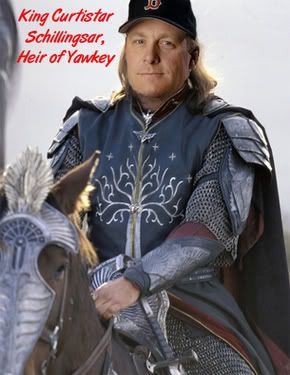
The evil Yankee Ringwraiths were no match for the might of King Schilling! (Many thanks to Mimiru and Batgirl for the photos)
Note to readers: Since I wrote this a few days ago (back when I thought the Yankees were a cinch to win the pennant) I also have a version with an alternate ending. You can read it here. I actually think it's better in some ways (except for accuracy, of course).
-Ryan M.
twinsfan21@msn.com
But they were all of them deceived. The Dark Lord Steinbrenner had lulled the free peoples of Middle Earth to sleep with feigned bouts of incompetence during the 1980s, all the while constructing a grand dynasty in secret. He finally unleashed his evil hordes in 1996, to the ruin of all. Braves (twice), Padres, Mets—all tried to challenge the Dark Lord, yet none were any match for his immense power and bottomless wallet. The baseball world plunged into a time of seemingly-endless darkness.
One by one, the free teams of Middle Earth fell to the power of the Ring, but there were some who resisted. The Arizona Diamondbacks, a motley collection of aging ballplayers from the desert, were stout of heart (and strong in pitching) and pushed the Dark Lord’s minions to the brink of elimination in 2001. Yet in Game 7, the battle seemed almost over: the Yankees held a one-run lead with their most terrible servant (Mariano Rivera) on the mound. It was in that moment, when all hope had faded, that Luis Gonzalez, star of the Diamondbacks, took up his sword and struck a mighty blow against evil. His Series-winning single cut the Ring from the hand of the Dark Lord.
Steinbrenner, enemy of the free peoples of Middle Earth, was defeated.
History became legend, and legend became myth. And for three long years, the Ring remained safely beyond the evil clutches of Steinbrenner. Following the in the Diamondbacks' stead, the Angels of Anaheim vanquished the Yankees once again in 2002. It was a strong-armed flamethrower from the southern reaches of Florida (Josh Beckett) that prevented a Yankee triumph in 2003. Meanwhile, the Dark Lord’s lust for his precious Ring grew insatiable. He vowed to spare neither expense nor revenue: the Ring would be his.
In 2004, rumor grew of a shadow in the AL East; whispers of a nameless fear encircled the baseball world. The Dark Lord Steinbrenner called together his most wicked minions, the terrible Ringwraiths, a collection of nine once noble All-Stars corrupted by greed and hatred. When the Dark Lord succeeded in twisting the fearsome Witch King of A-Rod to serve his malicious purposes, the free peoples of Major League Baseball were plunged into despair.
The Nine have terrorized the American League for the past six months, bludgeoning their payroll-poor opponents to death with a powerful offense and strong bullpen. Even the formidable Twins were no match for Steinbrenner’s minions earlier this postseason.
This set the stage for a final showdown between the forces of good and evil. The Red Sox of Boston, last vestiges of a long-suffering race, initially faltered under the heavy offensive onslaught of the Nine. The battle seemed all-but-over; the hordes of the Bronx were already eying their next conquest. The Ring was so close the Dark Lord could feel its presence.
Then, the unthinkable occurred. On the very brink of destruction, the Red Sox suddenly halted the march of Steinbrenner’s minions. The tide of battle had been turned.
“A day may come when the courage of men fails; when we forsake our friends, and break all bonds of fellowship,” proclaimed King Schilling, leader of the Sox. “But it is not this day. This day, we fight!”
Schilling, who carried upon his broad shoulders the hopes of Middle Earth, valiantly overcame his wounds and struck a critical blow against the Dark Lord. His performance on the very slopes of Mount Ruth allowed the Bostonian army to overcome incredible odds and force a decisive game seven. The unsung Johnny Damon then ensured the Shadow would be kept at bay for another year, completing a most improbable victory.
Although they have been defeated, the Dark Lord and his minions will not rest. His Eye is ever watchful, constantly searching for more free agents to seduce.
Yet for now, the free peoples of Middle Earth can sleep well, for certain doom has indeed been averted. The battle for the pennant is over. The battle for Middle Earth, however, has just begun.
The evil Yankee Ringwraiths were no match for the might of King Schilling! (Many thanks to Mimiru and Batgirl for the photos)
Note to readers: Since I wrote this a few days ago (back when I thought the Yankees were a cinch to win the pennant) I also have a version with an alternate ending. You can read it here. I actually think it's better in some ways (except for accuracy, of course).
-Ryan M.
twinsfan21@msn.com
Prelude to a Dream
Well folks, it's been pretty tough to concentrate on anything Twins-related these past few days. We're in the midst of history: before tonight's 4-2 Boston win in Game 6 of the ALCS, no team in the history of baseball had ever forced a Game 7 after falling behind three games to none in a series. I repeat: this has never happened before! To put this into perspective, consider this: since postseason play began back in 1903, there have been a total of 127 seven-game postseason series played (93 World Series and 34 seven-game LCS). This also takes into account that baseball had a 9-game World Series in 1903, 1905, 1919, 1920, and 1921. It also accounts for the lack of a postseason in 1904 and 1994, as well as the five-game ALCS and NLCS played from 1981-1984. I don't know what's more amazing, the fact that the Red Sox were able to accomplish this feat or the fact that it had never happened before in 127 chances! However, they haven't won anything yet. This could easily be all for naught if Derek Lowe can't keep the Yankees at least somewhat in check tonight. I don't know about you, but I'm going to be glued to my TV tonight!
Another reason today's abbreviated post is entitled "Prelude" has to do with what's on tap for tomorrow. I have a very entertaining post all written out for tomorrow night that I hope many people will enjoy. It isn't technically Twins-related, but rather the next best thing: Yankee-bashing. If that topic's not a winner, I don't know what is! Be sure and check out Twins Chatter tomorrow (or sometime after tonight's game). I don't think you'll be disappointed.
-Ryan M.
twinsfan21@msn.com
Another reason today's abbreviated post is entitled "Prelude" has to do with what's on tap for tomorrow. I have a very entertaining post all written out for tomorrow night that I hope many people will enjoy. It isn't technically Twins-related, but rather the next best thing: Yankee-bashing. If that topic's not a winner, I don't know what is! Be sure and check out Twins Chatter tomorrow (or sometime after tonight's game). I don't think you'll be disappointed.
-Ryan M.
twinsfan21@msn.com
Monday, October 18, 2004
Cabin Fever Strikes in Late October
I think I might have a problem. Recently, I have been acting a bit abnormally. This past weekend, upon discovering that the Twins would be bringing back Henry Blanco, I did the only thing I could do: I tailgated in my driveway to celebrate. It was kind of cold outside but the grill kept me warm as I laid back in my lawn chair and waxed poetically about the season that had just ended and what 2005 would bring. The people walking by didn’t seem to understand the significance of my catcher’s gear garb and my funky mullet hairdo. They gave me weird looks; my neighbor even asked me why I was having a "pow wow".
Can you believe I even received a noise complaint? They said I was playing “We’re Gonna Win Twins” too loud. Is that even possible? As far as I’m concerned that song could never constitute a civil disturbance.
What am I going to do all winter? At least I still have the $6 I won from a bet with Ryan during Game 4. While the going was still good I told Ryan that Blanco would hit a home run in an upcoming at-bat. Of course he didn’t believe me; lets be honest: no one in the whole place would have believed me. I could have easily made a cool million had I pursued it further. Then the mighty Henry "Babe" Blanco stepped to the plate and fulfilled my prophecy by slamming a go-ahead homerun to left about 100 rows lower then where we were sitting.
My sister keeps asking me if the Twins are going to bring back Doug Mientkiewicz this offseason. She says the team just wasn’t the same after his departure. For once, I would have to agree with her. There was a lot less noise eminating from off the field, while at the same time the team began to win more on it. Without controversey, what are would-be journalists like myself supposed to write about?
This also begs the question of what to do with the three Mientkiewicz jerseys/t-shirts in my closet right now. I tried ripping the name off the back of one of them but "Mientkiewicz" does not become "Betzler" as easily as one might think. In fact, all it really becomes is a more tattered-looking version of itself. Cutting the name off the back all together just looks tacky (it also really hurts the durability of the shirt). I ended up using the front of one as decoration in my bedroom because it said "Twins" and I had a large open space where I had taken down my "Free Mientkiewicz" poster. I am thinking about taking it down now though as my room as been radiating some bad karma ever since it went up.
Maybe I’ll just pack them all away and in 20 years or so if they still fit I can wear them and say they are retro.
Cristian Guzman may not be coming back to the Twins next year either. I have to admit I was pretty upset when I heard the news. I can’t help but remember him making that bionic sound as he ran the bases back in 2001, especially in that one game against Cleveland. Then I recall the creaking sounds he has made more recently as his game has significantly slowed down, despite the fact that he is still a very young man. Does anybody know what kind of sound Jason Bartlett or Nick Punto make when they play?
I’ll tell you one thing, the name "Omar Vizquel" sure has a nice ring to it, and "Edgar Renteria" just rolls off the tongue. I can see it now ...Radio guy: “When Edgar Renteria runs it makes that championship sound [cue Queen's 'We Are The Champions” as Renteria rounds the bases]". Too bad it will take another sound to sign either: "Cha-Ching!"
I have so much time on my hands that I actually do my homework these days! Unfortunately, it isn’t going as well as you might expect. Seems my teachers liked me more back when I was the quiet guy, riding the pine, waiting to get home for my next Twins baseball fix. Now they have to put up with questions about where Brad Radke fit in with the founding fathers and how the physical geography of Venezuela helped to produce great pitchers like Johan Santana and Juan Rincon. (I also asked what role continentality played in Rincon’s Game 4 implosion; still waiting on an answer for that one).
I was at the casino the other day and I could have sworn I saw Terry Ryan playing the slots. Maybe he was holding out hope that he could win enough to make up the difference between what old man Pohlad would be giving him for a budget and what it would take to resign Brad Radke and Corey Koskie with a little on the side to fill other needs. It didn’t look like he was doing too good. Joe Mauer may have to wait another year for that knee transplant we’ve all been waiting for.
Now that the season is over I have been trying to experience the rest of life. Did you know that college students actually go out and socialize on the weekends? It has been a little hard though. Every time I meet a girl and she wants to dance I ruin it by trying to show her my Torii Hunter-inspired "leap against the walls" move or my Johan Santana windup. These dance moves don’t mix well with the latest Jay-Z song. When I get the chance to talk to a girl I drive her away by describing why Michael Cuddyer is a better second baseman then Louis Rivas. Someday I will find a girl that understands.
I did have some luck one night though when I accidentally put on one of the aforementioned Mientkiewicz jerseys. I don’t know what it is, but girls love that jersey. I did not have as much luck the next night when I wore a Ron Gardenhire one for some reason.
It is only October, the playoffs are still going on and I’m already struggling with withdrawal. Every time David Ortiz has another big hit I go cold, then hot and then back to cold again. I got the shakes, which probably explain any punctuation problems inherent in this piece. I just can’t bring myself to let go and put away my 2004 Twins schedule for the winter. It hurts too much. I tried watching football instead, but unlike baseball you only get one game a week. I get all excited when Daunte throws 5 touchdowns and then I have to wait so long to see it again. There just isn’t enough to keep my interests in that game. So here I am, growing my hair long like Blanco waiting for Brad Radke to sign so I can throw another tailgating party. Anything to make the winter go by a little quicker.
Here is an excerpt of the conversation I had with my sister regarding Dougie "Baseball" Mientkiewicz:
My Sister: Do you think the Twins will resign Doug? I mean, he’s kind of cute and I miss him.
Me: *shudder* As far as I remember he is not a free agent…
Sis: Well I just bought a bunch of Mientkiewicz jerseys on sale; they are so cheap right now.
Me: You did what?
Sis: You know Justin Morneau is great but I think Doug got a real bad deal. He just wanted to play and let’s face it, he is a winner. I heard the guys on TV last night talk about how he is really a number three hitter for a playoff team! I’m pretty sure those guys know what they are talking about. Can’t we just trade Morneau for Doug? Do you think the Red Sox would do it? Maybe we could throw in Kubel or that one minor league pitcher guy whose kind of cocky.
Me: Well, you see the Fox announcers aren’t exactly right…
Sis: You can say a lot about Doug but at least he was never cocky, just confident. No team can have enough confidence. Maybe that was what we were missing against the Yankees.
Me: (Staring in disbelief)
Sis: Didn’t you see Doug get that big hit last night? Where was that last week when the Twins needed it? I’ll tell you where it was: in Boston!
Me: You mean the one in extra innings that nothing came of? He was in the on-deck circle when Ortiz won the game!
Sis: No I think Dougie was the guy and that, John, is why you will be receiving another Doug Mientkiewicz jersey for Christmas. You are going to look so cute!
(Note: There is absolutely no chance the Twins will sign Edgar Renteria this winter and Joe Mauer does not need a new knee just yet. Also, I need to admit that my sister is a very knowledgable Twins fan and in no way should this post take away from that.)
Can you believe I even received a noise complaint? They said I was playing “We’re Gonna Win Twins” too loud. Is that even possible? As far as I’m concerned that song could never constitute a civil disturbance.
What am I going to do all winter? At least I still have the $6 I won from a bet with Ryan during Game 4. While the going was still good I told Ryan that Blanco would hit a home run in an upcoming at-bat. Of course he didn’t believe me; lets be honest: no one in the whole place would have believed me. I could have easily made a cool million had I pursued it further. Then the mighty Henry "Babe" Blanco stepped to the plate and fulfilled my prophecy by slamming a go-ahead homerun to left about 100 rows lower then where we were sitting.
My sister keeps asking me if the Twins are going to bring back Doug Mientkiewicz this offseason. She says the team just wasn’t the same after his departure. For once, I would have to agree with her. There was a lot less noise eminating from off the field, while at the same time the team began to win more on it. Without controversey, what are would-be journalists like myself supposed to write about?
This also begs the question of what to do with the three Mientkiewicz jerseys/t-shirts in my closet right now. I tried ripping the name off the back of one of them but "Mientkiewicz" does not become "Betzler" as easily as one might think. In fact, all it really becomes is a more tattered-looking version of itself. Cutting the name off the back all together just looks tacky (it also really hurts the durability of the shirt). I ended up using the front of one as decoration in my bedroom because it said "Twins" and I had a large open space where I had taken down my "Free Mientkiewicz" poster. I am thinking about taking it down now though as my room as been radiating some bad karma ever since it went up.
Maybe I’ll just pack them all away and in 20 years or so if they still fit I can wear them and say they are retro.
Cristian Guzman may not be coming back to the Twins next year either. I have to admit I was pretty upset when I heard the news. I can’t help but remember him making that bionic sound as he ran the bases back in 2001, especially in that one game against Cleveland. Then I recall the creaking sounds he has made more recently as his game has significantly slowed down, despite the fact that he is still a very young man. Does anybody know what kind of sound Jason Bartlett or Nick Punto make when they play?
I’ll tell you one thing, the name "Omar Vizquel" sure has a nice ring to it, and "Edgar Renteria" just rolls off the tongue. I can see it now ...Radio guy: “When Edgar Renteria runs it makes that championship sound [cue Queen's 'We Are The Champions” as Renteria rounds the bases]". Too bad it will take another sound to sign either: "Cha-Ching!"
I have so much time on my hands that I actually do my homework these days! Unfortunately, it isn’t going as well as you might expect. Seems my teachers liked me more back when I was the quiet guy, riding the pine, waiting to get home for my next Twins baseball fix. Now they have to put up with questions about where Brad Radke fit in with the founding fathers and how the physical geography of Venezuela helped to produce great pitchers like Johan Santana and Juan Rincon. (I also asked what role continentality played in Rincon’s Game 4 implosion; still waiting on an answer for that one).
I was at the casino the other day and I could have sworn I saw Terry Ryan playing the slots. Maybe he was holding out hope that he could win enough to make up the difference between what old man Pohlad would be giving him for a budget and what it would take to resign Brad Radke and Corey Koskie with a little on the side to fill other needs. It didn’t look like he was doing too good. Joe Mauer may have to wait another year for that knee transplant we’ve all been waiting for.
Now that the season is over I have been trying to experience the rest of life. Did you know that college students actually go out and socialize on the weekends? It has been a little hard though. Every time I meet a girl and she wants to dance I ruin it by trying to show her my Torii Hunter-inspired "leap against the walls" move or my Johan Santana windup. These dance moves don’t mix well with the latest Jay-Z song. When I get the chance to talk to a girl I drive her away by describing why Michael Cuddyer is a better second baseman then Louis Rivas. Someday I will find a girl that understands.
I did have some luck one night though when I accidentally put on one of the aforementioned Mientkiewicz jerseys. I don’t know what it is, but girls love that jersey. I did not have as much luck the next night when I wore a Ron Gardenhire one for some reason.
It is only October, the playoffs are still going on and I’m already struggling with withdrawal. Every time David Ortiz has another big hit I go cold, then hot and then back to cold again. I got the shakes, which probably explain any punctuation problems inherent in this piece. I just can’t bring myself to let go and put away my 2004 Twins schedule for the winter. It hurts too much. I tried watching football instead, but unlike baseball you only get one game a week. I get all excited when Daunte throws 5 touchdowns and then I have to wait so long to see it again. There just isn’t enough to keep my interests in that game. So here I am, growing my hair long like Blanco waiting for Brad Radke to sign so I can throw another tailgating party. Anything to make the winter go by a little quicker.
Here is an excerpt of the conversation I had with my sister regarding Dougie "Baseball" Mientkiewicz:
My Sister: Do you think the Twins will resign Doug? I mean, he’s kind of cute and I miss him.
Me: *shudder* As far as I remember he is not a free agent…
Sis: Well I just bought a bunch of Mientkiewicz jerseys on sale; they are so cheap right now.
Me: You did what?
Sis: You know Justin Morneau is great but I think Doug got a real bad deal. He just wanted to play and let’s face it, he is a winner. I heard the guys on TV last night talk about how he is really a number three hitter for a playoff team! I’m pretty sure those guys know what they are talking about. Can’t we just trade Morneau for Doug? Do you think the Red Sox would do it? Maybe we could throw in Kubel or that one minor league pitcher guy whose kind of cocky.
Me: Well, you see the Fox announcers aren’t exactly right…
Sis: You can say a lot about Doug but at least he was never cocky, just confident. No team can have enough confidence. Maybe that was what we were missing against the Yankees.
Me: (Staring in disbelief)
Sis: Didn’t you see Doug get that big hit last night? Where was that last week when the Twins needed it? I’ll tell you where it was: in Boston!
Me: You mean the one in extra innings that nothing came of? He was in the on-deck circle when Ortiz won the game!
Sis: No I think Dougie was the guy and that, John, is why you will be receiving another Doug Mientkiewicz jersey for Christmas. You are going to look so cute!
(Note: There is absolutely no chance the Twins will sign Edgar Renteria this winter and Joe Mauer does not need a new knee just yet. Also, I need to admit that my sister is a very knowledgable Twins fan and in no way should this post take away from that.)
2004: A Mauer Odyssey
2004 began as a year of unknowns for the defending Central Division Champion Minnesota Twins, but many fans consider that to be a source of excitement. One of the (few) joys of rooting for a small market franchise is the heightened sense of anticipation that surrounds the new team each spring. The most pressing concern for Yankee fans, for example, is whether the team will win 100 or 105 games during the regular season. Such is not the case here in the land o' lakes. The words “high expectations” and “Twins fan” have not traditionally gone hand in hand over the years.
This spring, we had many important questions that could only be answered over the course of 162 games. Could Carlos Silva develop into a serviceable starter? Would talent translate into performance in the Twins’ bullpen? Would the offense finally develop some consistently? The answers to those questions were determined (yes, yes, and no), as were the answers to dozens of others. However, one of the spring’s most intriguing issues was not fully illuminated: How would Minnesota favorite son and über-prospect Joe Mauer handle his role as the team’s everyday catcher?
Unfortunately, a definitive answer to that question never came. Below is a timeline of Mauer’s rookie season. As you can see, while there were some ups, they were far outweighed by the downs.
April 5: Went 2-for-3 with two walks and two runs scored in major league debut.
April 6: Injured left knee sliding while chasing a foul pop.
April 7: Placed on disabled list and underwent surgery to repair a left medial meniscus tear.
June 3: Returned to active roster.
June 6: Hit first major league home run, off Detroit's Esteban Yan.
June 11: Went 3-for-3 with a homer and two RBI to raise average to .346.
July 2: Elevated to No. 3 spot in Twins batting order.
July 7: Went 4-for-5 to push average to .340.
July 15: Struck out as pinch hitter in last regular-season appearance.
July 19: Placed on disabled list for second time.
Aug. 12: Passes two kidney stones and has a third removed.
Sept. 24: Exam ruled out additional surgery on knee, and rehab intensified.
Oct. 14: Experiences discomfort after light-to-moderate catching activities in Florida
Oct. 16: Given clean bill of health after scare, will play in Instructional League games this fall
Here are Mauer’s final totals for 2004:
The Verdict: The sample size was very small (about 1/5 of a season) but Joe was clearly one of the team’s best players when healthy this season. Very few people thought that he would hit for much power as a rookie, especially considering that he just four homers in 2003 at AA, but Mauer surprised us with six home runs and an outstanding .570 slugging percentage. He was also extremely good behind the plate, committing just two errors and throwing out 7 of 18 potential base stealers (39%). Longtime Orioles scout Deacon Jones summed it up perfectly earlier this season: “Everything you’ve heard about this kid is true.” For those 35 games, almost everyone’s expectations were exceeded. Mauer had been moved up to the #3 spot in the order and was actually producing (unlike Hunter, Koskie, and Mientkiewicz). He was even drawing some Rookie of the Year interest, despite the fact that he had missed the previous two months.
Unfortunately, it was all too good to be true. I guess it was too much to ask from the baseball gods that everything would go right this season, although we did catch our fair share of breaks overall. Mauer didn’t play after mid-July, and it was feared for a while that he might never catch again. While that doesn’t appear to be the case anymore, 2004 was pretty much a wash for Joe. We glimpsed his potential, but he simply wasn’t healthy enough for anyone to fully determine how he will perform at the major league level over the next few years.
The Future: We may not have a seasons-worth of information to go off, but that’s not going to stop me from speculating about 2005 and beyond! I firmly believe that Mauer will be the team’s Opening Day catcher once again next year. The fact that he was able to overcome this most recent hurdle is a very good sign for Joe, as he’s shown that every little setback is no longer a possibly career-threatening turn of events. Everything I’ve heard about the nature of this injury points to a full recovery. The knee can function normally without the meniscus for a very long period of time; it just takes a while for the body to get acclimated to life without it. Mauer is slowly getting used to this, and he seems to be making good progress.
I fully expect to see nearly a year’s-worth of June/July numbers from Joe in 2005: batting average around .300, perhaps 20-25 homers, and 85-90 RBIs with an OPS around .850. I had tempered expectations entering 2004 because I wasn’t sure how long it would take him to adjust to big league pitching, but the old axiom proved true: with the right swing, you can hit at any level. Joe’s got one of the sweetest swings around, and I can’t wait to see him put in a full season.
Major league pitchers, consider yourselves forewarned. You ain’t gonna be so lucky next year.
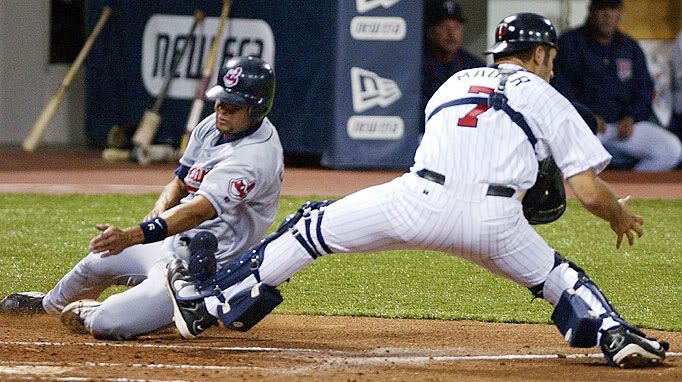
This was a scene we saw far too seldomly in 2004—Joe Mauer on the field.
If you're actually still reading this far down the page, you might be interested to know that I went 12-1 this week with my football picks over at Seth Speaks (outdistancing a talented field of 11 other "experts"). I am one of those unfortunate people who never wins anything, so please allow me a brief moment of celebration: Boo yah!
Thank you. We now return you to your regularly scheduled Twins discussion.
This spring, we had many important questions that could only be answered over the course of 162 games. Could Carlos Silva develop into a serviceable starter? Would talent translate into performance in the Twins’ bullpen? Would the offense finally develop some consistently? The answers to those questions were determined (yes, yes, and no), as were the answers to dozens of others. However, one of the spring’s most intriguing issues was not fully illuminated: How would Minnesota favorite son and über-prospect Joe Mauer handle his role as the team’s everyday catcher?
Unfortunately, a definitive answer to that question never came. Below is a timeline of Mauer’s rookie season. As you can see, while there were some ups, they were far outweighed by the downs.
April 5: Went 2-for-3 with two walks and two runs scored in major league debut.
April 6: Injured left knee sliding while chasing a foul pop.
April 7: Placed on disabled list and underwent surgery to repair a left medial meniscus tear.
June 3: Returned to active roster.
June 6: Hit first major league home run, off Detroit's Esteban Yan.
June 11: Went 3-for-3 with a homer and two RBI to raise average to .346.
July 2: Elevated to No. 3 spot in Twins batting order.
July 7: Went 4-for-5 to push average to .340.
July 15: Struck out as pinch hitter in last regular-season appearance.
July 19: Placed on disabled list for second time.
Aug. 12: Passes two kidney stones and has a third removed.
Sept. 24: Exam ruled out additional surgery on knee, and rehab intensified.
Oct. 14: Experiences discomfort after light-to-moderate catching activities in Florida
Oct. 16: Given clean bill of health after scare, will play in Instructional League games this fall
Here are Mauer’s final totals for 2004:
| G | AB | R | H | 2B | HR | RBI | BB | SO | BA | OPS | SLG | OPS |
|---|---|---|---|---|---|---|---|---|---|---|---|---|
| 35 | 107 | 18 | 33 | 8 | 6 | 17 | 11 | 14 | .308 | .369 | .570 | .939 |
The Verdict: The sample size was very small (about 1/5 of a season) but Joe was clearly one of the team’s best players when healthy this season. Very few people thought that he would hit for much power as a rookie, especially considering that he just four homers in 2003 at AA, but Mauer surprised us with six home runs and an outstanding .570 slugging percentage. He was also extremely good behind the plate, committing just two errors and throwing out 7 of 18 potential base stealers (39%). Longtime Orioles scout Deacon Jones summed it up perfectly earlier this season: “Everything you’ve heard about this kid is true.” For those 35 games, almost everyone’s expectations were exceeded. Mauer had been moved up to the #3 spot in the order and was actually producing (unlike Hunter, Koskie, and Mientkiewicz). He was even drawing some Rookie of the Year interest, despite the fact that he had missed the previous two months.
Unfortunately, it was all too good to be true. I guess it was too much to ask from the baseball gods that everything would go right this season, although we did catch our fair share of breaks overall. Mauer didn’t play after mid-July, and it was feared for a while that he might never catch again. While that doesn’t appear to be the case anymore, 2004 was pretty much a wash for Joe. We glimpsed his potential, but he simply wasn’t healthy enough for anyone to fully determine how he will perform at the major league level over the next few years.
The Future: We may not have a seasons-worth of information to go off, but that’s not going to stop me from speculating about 2005 and beyond! I firmly believe that Mauer will be the team’s Opening Day catcher once again next year. The fact that he was able to overcome this most recent hurdle is a very good sign for Joe, as he’s shown that every little setback is no longer a possibly career-threatening turn of events. Everything I’ve heard about the nature of this injury points to a full recovery. The knee can function normally without the meniscus for a very long period of time; it just takes a while for the body to get acclimated to life without it. Mauer is slowly getting used to this, and he seems to be making good progress.
I fully expect to see nearly a year’s-worth of June/July numbers from Joe in 2005: batting average around .300, perhaps 20-25 homers, and 85-90 RBIs with an OPS around .850. I had tempered expectations entering 2004 because I wasn’t sure how long it would take him to adjust to big league pitching, but the old axiom proved true: with the right swing, you can hit at any level. Joe’s got one of the sweetest swings around, and I can’t wait to see him put in a full season.
Major league pitchers, consider yourselves forewarned. You ain’t gonna be so lucky next year.
This was a scene we saw far too seldomly in 2004—Joe Mauer on the field.
If you're actually still reading this far down the page, you might be interested to know that I went 12-1 this week with my football picks over at Seth Speaks (outdistancing a talented field of 11 other "experts"). I am one of those unfortunate people who never wins anything, so please allow me a brief moment of celebration: Boo yah!
Thank you. We now return you to your regularly scheduled Twins discussion.
Friday, October 15, 2004
The Keys to Success
The off-season is an opportunity to improve. The decisions a team makes now will determine how far they get next year. One good move can make the difference between going home early and winning it all. Last year at this time, many Twins fans had never heard of Joe Nathan; they only knew Lew Ford as a mid-level prospect and had heard Justin Morneau had some pop in his bat. This year it is no different as the Twins, once again, have some work to do to go for their fourth straight division title. During the off-season they must continue to develop their lifeline of young players. They also need to get healthy from a long season and look at what free agency has to offer. They must explore trades, decide whom they are going to re-sign and think about what other changes need to be made to next year's team. Add it all up and you get the keys to a successful off-season for the Minnesota Twins.
Continued Development –
The Twins are a small market team and as such their lifeline is their farm system. Players such as JD Durbin, Scott Baker, Jesse Crain, Jason Kubel and Jason Bartlett are playing in the Arizona Fall league right now. These players need to continue to improve because they need to play a big part in the Twins success next year. Kubel will probably start in right, Crain will be a vital part of the bullpen, Baker and Durbin will both compete for spots in the rotation and Bartlett might have to replace Cristian Guzman at short. These players need to take advantage of the winter so that they are ready to contribute next year otherwise the Twins will have to scramble to find alternatives to fill the voids.
Getting Healthy –
Imagine what the lineup would have looked like with a healthy Joe Mauer against the Yankees. In his brief time with the club this year, Mauer looked like a patient, polished hitter. He will make a great 2nd or 3rd hitter if healthy. Joe Mays is another player who can contribute. He is coming off of Tommy John surgery and had several set backs this past season. He may not be worth the 7+million he is making but he will add needed competition to the rotation and is capable of being a solid third starter when healthy. Grant Balfour is another pitcher whose injuries prevented him from showing what he could really do; an off-season of rest should fix that. Louis Rivas was also injured at the end of the year but it makes no difference, his job should and will belong to Michael Cuddyer next spring and Rivas might not even be with the team.
Going After Free Agency –
The Twins need to identify their needs. If they decide not to bring back Corey Koskie, Cristian Guzman or Brad Radke they will be looking outside the organization for some kind of replacement. The reality is that Carl Pohlad is not going to increase the payroll and once again Terry Ryan is going to have to be creative. This means you aren’t going to see Edgar Renteria or Roger Clemons in a Twins uniform. It does mean the Twins will probably add bit players, they think can help, like they did with Henry Blanco and Joe Roa last year. Any trades they make could also define what they go after. As it stands, they could be in the market for a left-handed reliever, players for the right side of the infield and if Radke walks, a modestly priced free agent pitcher.
Resigning the Right Players –
Which of course brings us to the determination of which players to resign. Brad Radke is a must. There is no other pitcher out there who will bring as much to the table for the price the Twins should be able to get him for. He is the heart and soul of the pitching staff. Johan Santana is more dominant but Radke has been eating innings for years and keeps the rotation consistent. He is a well respected team leader and gives the team a chance to win almost every time out. The decisions on Koskie and Guzman are a little more difficult. Koskie is a big part of team chemistry but also has had health problems. The team has a replacement waiting in Terry Tiffee but can’t expect him to duplicate his numbers from early September. Guzman is probably not worth his 5+ million option but might be a bargain if brought back at a reduced price. Jason Bartlett does not appear ready to take over with the glove at this time and there are not a lot of better, cheaper options in free agency. Other players, such as Henry Blanco, Joe Roa and Jose Offerman, the team will have to make a decision as to whether to bring back as well.
Dealing With Changes –
The team knows that Jacque Jones will not be back next year. There is no way the Twins will pick up his option with several replacements waiting in the wings. Their lineup will be different with Joe Mauer back. They need to decide where they want to bat him. They will probably base his placement in the order on how often he is able to be in the lineup and catch. The lineup is always changing and the Twins will have to settle on what they believe will work best next year. If Brad Radke leaves it will leave a huge void in the rotation that someone will have to step up and fill. Some players will step up while others will inevitably regress.
Those, friends, are the keys to the 2004-2005 off-season for the Twins. This year may not have has much turmoil as last year but some changes are afoot. It will be interesting to see what kind of trades go down, who is brought back and how some players progress during the off season. It is a wild time in baseball and although the Twins are not the biggest players they seem to always make a splash.
(Note that Baseball Reference has updated their stats for 2004. You can check them out by clicking the link on the left of this site.)
Continued Development –
The Twins are a small market team and as such their lifeline is their farm system. Players such as JD Durbin, Scott Baker, Jesse Crain, Jason Kubel and Jason Bartlett are playing in the Arizona Fall league right now. These players need to continue to improve because they need to play a big part in the Twins success next year. Kubel will probably start in right, Crain will be a vital part of the bullpen, Baker and Durbin will both compete for spots in the rotation and Bartlett might have to replace Cristian Guzman at short. These players need to take advantage of the winter so that they are ready to contribute next year otherwise the Twins will have to scramble to find alternatives to fill the voids.
Getting Healthy –
Imagine what the lineup would have looked like with a healthy Joe Mauer against the Yankees. In his brief time with the club this year, Mauer looked like a patient, polished hitter. He will make a great 2nd or 3rd hitter if healthy. Joe Mays is another player who can contribute. He is coming off of Tommy John surgery and had several set backs this past season. He may not be worth the 7+million he is making but he will add needed competition to the rotation and is capable of being a solid third starter when healthy. Grant Balfour is another pitcher whose injuries prevented him from showing what he could really do; an off-season of rest should fix that. Louis Rivas was also injured at the end of the year but it makes no difference, his job should and will belong to Michael Cuddyer next spring and Rivas might not even be with the team.
Going After Free Agency –
The Twins need to identify their needs. If they decide not to bring back Corey Koskie, Cristian Guzman or Brad Radke they will be looking outside the organization for some kind of replacement. The reality is that Carl Pohlad is not going to increase the payroll and once again Terry Ryan is going to have to be creative. This means you aren’t going to see Edgar Renteria or Roger Clemons in a Twins uniform. It does mean the Twins will probably add bit players, they think can help, like they did with Henry Blanco and Joe Roa last year. Any trades they make could also define what they go after. As it stands, they could be in the market for a left-handed reliever, players for the right side of the infield and if Radke walks, a modestly priced free agent pitcher.
Resigning the Right Players –
Which of course brings us to the determination of which players to resign. Brad Radke is a must. There is no other pitcher out there who will bring as much to the table for the price the Twins should be able to get him for. He is the heart and soul of the pitching staff. Johan Santana is more dominant but Radke has been eating innings for years and keeps the rotation consistent. He is a well respected team leader and gives the team a chance to win almost every time out. The decisions on Koskie and Guzman are a little more difficult. Koskie is a big part of team chemistry but also has had health problems. The team has a replacement waiting in Terry Tiffee but can’t expect him to duplicate his numbers from early September. Guzman is probably not worth his 5+ million option but might be a bargain if brought back at a reduced price. Jason Bartlett does not appear ready to take over with the glove at this time and there are not a lot of better, cheaper options in free agency. Other players, such as Henry Blanco, Joe Roa and Jose Offerman, the team will have to make a decision as to whether to bring back as well.
Dealing With Changes –
The team knows that Jacque Jones will not be back next year. There is no way the Twins will pick up his option with several replacements waiting in the wings. Their lineup will be different with Joe Mauer back. They need to decide where they want to bat him. They will probably base his placement in the order on how often he is able to be in the lineup and catch. The lineup is always changing and the Twins will have to settle on what they believe will work best next year. If Brad Radke leaves it will leave a huge void in the rotation that someone will have to step up and fill. Some players will step up while others will inevitably regress.
Those, friends, are the keys to the 2004-2005 off-season for the Twins. This year may not have has much turmoil as last year but some changes are afoot. It will be interesting to see what kind of trades go down, who is brought back and how some players progress during the off season. It is a wild time in baseball and although the Twins are not the biggest players they seem to always make a splash.
(Note that Baseball Reference has updated their stats for 2004. You can check them out by clicking the link on the left of this site.)
Wednesday, October 13, 2004
Waxing Poetically
Well, it’s now official. I have moved on from last week’s disappointment(s) and have accepted the fact that the long, dark, cold Minnesota winter is well on its way. However, let us not so easily forget those joyous times of spring and summer, when we basked in the light of our favorite hometown nine. Let us push aside thoughts of impending doom and instead relive the glorious moments of our (relative) youth. Let us look back at the highlights from the 2004 Minnesota Twins.
April
Ah, April. What a month that was. No one knew how the new-look Twins would respond to the rigors of major league competition. Would the bullpen fall apart? Would the rotation crumble? Shannon Stewart made us forget all those questions with one swing of the bat on Opening Day. His three-run homer in the 11th inning led the Twins to a 7-4 victory that night. Man, what a game! You simply had to be there in person.
The Twins jumped out to a 15-7 record in April, which was due in large part to the efforts of two men: “Sweet” Lew Ford and Carlos Silva. Ford (who, in case you didn’t know, was named Official Player of Twins Chatter on April 23) was simply amazing: despite starting the year at AAA he hit .419 with 17 RBIs and a 1.181 OPS in April. Silva was almost as good, going 4-0 with a 4.02 ERA in the month. Even Henry “Babe” Blanco and Jose Offerman got into the act! April truly was an improbable month, as the Twins finished at the top of the league in hitting yet almost dead last in pitching. Looking back, it seems like a lifetime ago!
May
May was a month of ups and downs. The Twins would temporarily relinquish their division lead to the White Sox, although it would never get too far out of reach. Since we are indeed “waxing poetically”, I’ll focus more on the positive moments for now. Who could forget Matty LeCroy’s amazing ninth inning, two-out, pinch-hit, game-winning grand slam in Toronto on May 19? I doubt many of you saw the play live since it happened at about two in the afternoon, but it was a moment I will never forget. That at-bat simply could not have been scripted any better. May might have been a rather forgettable month for the Twins in general (Johan pitching like crap, numerous losing streaks) there is always a light to be found even in the darkest of places.
June
June may not have been the best of months for the team (the Twins posted a 16-14 record) but it was one of many memorable moments. Remember the day Jose “Awfulman” became, well, just regular Jose “Offermann”? It was June 10. It seemed the Twins were on the verge of wasting yet another strong pitching performance, this one by Kyle Lohse, when Offerman pinch-hit with two outs in the bottom of the ninth. LeCroy, of all people, was the runner on first. I remember watching almost in a state of shock when Offerman somehow redirected a 97-mph fastball from Mets closer Braden Looper to the leftcenter gap. Amazingly, LeCroy somehow made it all the way around the bases on that double, and with a little help from CF Mike Cameron, the Twins were able to tie the game. In the 15th inning of that same game, Mike Ryan’s strange infield single would send the Twins faithful home happy. What a game!
June could also be known as the “Month of Joe”, as it was the only full month Twins fans got to see their favorite hometown prodigy, Joe Mauer. One thing was for certain: Joe did not disappoint. He hit his first major league homer on June 6, a mammoth three-run go-ahead shot in the 8th inning, was almost cause for celebration in the Twin Cities. Joe hit four more homers that month and had 11 RBIs, definitely establishing himself as one of the team’s best all-around players. We may have only had a month and a half of Mauer (he didn’t play after July 15) but it gave us a sneak peak at what’s in store for 2005.
Towards the end of June, we also saw a rediscovery of sorts from a guy named Johan Santana. Little did we know what lay in store over the coming months…
July
If June was the “Month of Joe”, then July 2004 must heretofore be known as the “Month of Johan”. Simply put, Santana was utterly brilliant. The Twins’ offense was still in the throes of the “sucking time” (according to Batgirl) but Johan did everything but suck. He allowed only 14(!) hits and 6(!) earned runs in 46 innings that month, which is nothing short of Orel Hershiser mind-boggling. He won only three of six starts, but posted a 1.17. We all remember that the Yankees got nine hits off Johan the other day, but back in July, teams simply did not get hits off Santana! Teams considered themselves lucky if they scraped together three hits and a run during a Santana start! August and September were also great months for the soon-to-be Cy Young (he won the AL Pitcher of the Month award all three times) but July was when the best was at his best.
July was a time of brilliance on field for the Twins (the team won 10 of 12 to close out the month) but it was a time of controversy off the field. Doug Mientkiewicz had struggled with injuries somewhat in the first half, and when he came off the D.L. in mid-July, the Twins had a decision to make. Doug most assuredly did not play well in the first half, hitting .238 with only 5 homers and 23 RBIs in 281 at-bats. His replacement, Justin Morneau, had become the Twins’ most legitimate power threat and had to play every day. The news of Dougie Baseball’s “impending” trade broke a week early (I waxed poetically then also), and eventually, he was shipped to Boston. In his last weeks as a Twin, Mientkiewicz had become a loudmouth in the media and a distraction in the clubhouse. It was time to move on, even though it didn’t happen on the best of terms.
August
August 2004 will forever remembered for that one shining moment: Corey Koskie watching his 10th inning 2-run homer sail over the rightfield fence on August 15. Looking back, it truly was the swing that saved a season (the infamous broken chair deserves a little credit too). But just how did the Twins end up in such a situation? After tearing through the league with a red-hot 13 of 15 stretch in late July and early August, the Twins promptly went into one of their patented funks. During this time, the Indians happened to be playing their best baseball of the season. The Twins rolled into Cleveland for a key three-game series and were pounded into the ground twice. Koskie’s homer allowed the Twins to leave Cleveland with their dignity and first-place intact, and they would never look back. A Metrodome sweep of the Tribe the very next weekend essentially eliminated them from contention, and it was only a matter of time before the West (err, I mean Central) would be won.
Quick side note: I would be remiss if I didn’t mention the extremely entertaining series the Twins played with the Yankees in mid-July, taking two of three in convincing fashion. That success may not have translated into October, but it did make clear the fact that this Minnesota Twins team was for real.
September
Compared to the rest of the year, September was a rather uneventful month for our Twins. The collective August collapses of Cleveland and Chicago made a third straight division crown all but a certainty, but the Twins continued to pour it on (and I’m not talking about that giant milk bottle in right field). The Twins won 13 of their first 15 games in September, including nine in a row at one point. They would finally clinch (in Chicago, no less) on September 20. We also got to see plenty of up-and-coming Twins last month, the most notable being Terry Tiffee and Jason Kubel. Terry Ryan’s magic touch seems to know no bounds, as both players were impressive in their debuts and should contribute in 2005 as well.
Well, there you have it: your 2004 Minnesota Twins month by month. Today’s entry deviated slightly from my usual, but as always, it was fun to write. Because of the way the season ended, it’s easy to forget all the good times we experienced over the previous six months. It was one helluva ride. I don’t know about you, but I can’t wait to do it all over again next year.
-Ryan Maus
twinsfan21@msn.com
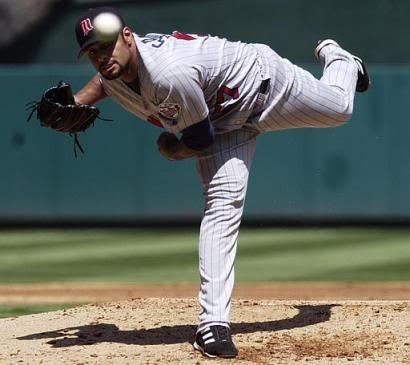
The man who made it all possible: Johan "K." Santana
Have any favorite memories of your own that I neglected? Torii's South Side collision? Louie's controversial "home run"? Don't hesitate to voice your thoughts in the comments section below! There are plenty of memorable moments to choose from, and it I think you'd be surprised at how vivid some of those memories seem!
April
Ah, April. What a month that was. No one knew how the new-look Twins would respond to the rigors of major league competition. Would the bullpen fall apart? Would the rotation crumble? Shannon Stewart made us forget all those questions with one swing of the bat on Opening Day. His three-run homer in the 11th inning led the Twins to a 7-4 victory that night. Man, what a game! You simply had to be there in person.
The Twins jumped out to a 15-7 record in April, which was due in large part to the efforts of two men: “Sweet” Lew Ford and Carlos Silva. Ford (who, in case you didn’t know, was named Official Player of Twins Chatter on April 23) was simply amazing: despite starting the year at AAA he hit .419 with 17 RBIs and a 1.181 OPS in April. Silva was almost as good, going 4-0 with a 4.02 ERA in the month. Even Henry “Babe” Blanco and Jose Offerman got into the act! April truly was an improbable month, as the Twins finished at the top of the league in hitting yet almost dead last in pitching. Looking back, it seems like a lifetime ago!
May
May was a month of ups and downs. The Twins would temporarily relinquish their division lead to the White Sox, although it would never get too far out of reach. Since we are indeed “waxing poetically”, I’ll focus more on the positive moments for now. Who could forget Matty LeCroy’s amazing ninth inning, two-out, pinch-hit, game-winning grand slam in Toronto on May 19? I doubt many of you saw the play live since it happened at about two in the afternoon, but it was a moment I will never forget. That at-bat simply could not have been scripted any better. May might have been a rather forgettable month for the Twins in general (Johan pitching like crap, numerous losing streaks) there is always a light to be found even in the darkest of places.
June
June may not have been the best of months for the team (the Twins posted a 16-14 record) but it was one of many memorable moments. Remember the day Jose “Awfulman” became, well, just regular Jose “Offermann”? It was June 10. It seemed the Twins were on the verge of wasting yet another strong pitching performance, this one by Kyle Lohse, when Offerman pinch-hit with two outs in the bottom of the ninth. LeCroy, of all people, was the runner on first. I remember watching almost in a state of shock when Offerman somehow redirected a 97-mph fastball from Mets closer Braden Looper to the leftcenter gap. Amazingly, LeCroy somehow made it all the way around the bases on that double, and with a little help from CF Mike Cameron, the Twins were able to tie the game. In the 15th inning of that same game, Mike Ryan’s strange infield single would send the Twins faithful home happy. What a game!
June could also be known as the “Month of Joe”, as it was the only full month Twins fans got to see their favorite hometown prodigy, Joe Mauer. One thing was for certain: Joe did not disappoint. He hit his first major league homer on June 6, a mammoth three-run go-ahead shot in the 8th inning, was almost cause for celebration in the Twin Cities. Joe hit four more homers that month and had 11 RBIs, definitely establishing himself as one of the team’s best all-around players. We may have only had a month and a half of Mauer (he didn’t play after July 15) but it gave us a sneak peak at what’s in store for 2005.
Towards the end of June, we also saw a rediscovery of sorts from a guy named Johan Santana. Little did we know what lay in store over the coming months…
July
If June was the “Month of Joe”, then July 2004 must heretofore be known as the “Month of Johan”. Simply put, Santana was utterly brilliant. The Twins’ offense was still in the throes of the “sucking time” (according to Batgirl) but Johan did everything but suck. He allowed only 14(!) hits and 6(!) earned runs in 46 innings that month, which is nothing short of Orel Hershiser mind-boggling. He won only three of six starts, but posted a 1.17. We all remember that the Yankees got nine hits off Johan the other day, but back in July, teams simply did not get hits off Santana! Teams considered themselves lucky if they scraped together three hits and a run during a Santana start! August and September were also great months for the soon-to-be Cy Young (he won the AL Pitcher of the Month award all three times) but July was when the best was at his best.
July was a time of brilliance on field for the Twins (the team won 10 of 12 to close out the month) but it was a time of controversy off the field. Doug Mientkiewicz had struggled with injuries somewhat in the first half, and when he came off the D.L. in mid-July, the Twins had a decision to make. Doug most assuredly did not play well in the first half, hitting .238 with only 5 homers and 23 RBIs in 281 at-bats. His replacement, Justin Morneau, had become the Twins’ most legitimate power threat and had to play every day. The news of Dougie Baseball’s “impending” trade broke a week early (I waxed poetically then also), and eventually, he was shipped to Boston. In his last weeks as a Twin, Mientkiewicz had become a loudmouth in the media and a distraction in the clubhouse. It was time to move on, even though it didn’t happen on the best of terms.
August
August 2004 will forever remembered for that one shining moment: Corey Koskie watching his 10th inning 2-run homer sail over the rightfield fence on August 15. Looking back, it truly was the swing that saved a season (the infamous broken chair deserves a little credit too). But just how did the Twins end up in such a situation? After tearing through the league with a red-hot 13 of 15 stretch in late July and early August, the Twins promptly went into one of their patented funks. During this time, the Indians happened to be playing their best baseball of the season. The Twins rolled into Cleveland for a key three-game series and were pounded into the ground twice. Koskie’s homer allowed the Twins to leave Cleveland with their dignity and first-place intact, and they would never look back. A Metrodome sweep of the Tribe the very next weekend essentially eliminated them from contention, and it was only a matter of time before the West (err, I mean Central) would be won.
Quick side note: I would be remiss if I didn’t mention the extremely entertaining series the Twins played with the Yankees in mid-July, taking two of three in convincing fashion. That success may not have translated into October, but it did make clear the fact that this Minnesota Twins team was for real.
September
Compared to the rest of the year, September was a rather uneventful month for our Twins. The collective August collapses of Cleveland and Chicago made a third straight division crown all but a certainty, but the Twins continued to pour it on (and I’m not talking about that giant milk bottle in right field). The Twins won 13 of their first 15 games in September, including nine in a row at one point. They would finally clinch (in Chicago, no less) on September 20. We also got to see plenty of up-and-coming Twins last month, the most notable being Terry Tiffee and Jason Kubel. Terry Ryan’s magic touch seems to know no bounds, as both players were impressive in their debuts and should contribute in 2005 as well.
Well, there you have it: your 2004 Minnesota Twins month by month. Today’s entry deviated slightly from my usual, but as always, it was fun to write. Because of the way the season ended, it’s easy to forget all the good times we experienced over the previous six months. It was one helluva ride. I don’t know about you, but I can’t wait to do it all over again next year.
-Ryan Maus
twinsfan21@msn.com
The man who made it all possible: Johan "K." Santana
Have any favorite memories of your own that I neglected? Torii's South Side collision? Louie's controversial "home run"? Don't hesitate to voice your thoughts in the comments section below! There are plenty of memorable moments to choose from, and it I think you'd be surprised at how vivid some of those memories seem!
Monday, October 11, 2004
Handing Out the Hardware
I woke up yesterday morning still in disbelief. It had been two days since I had sat in row 33 of left field and watched as Juan Rincon gave up a 3 run home run to tie a game that the Yankees would eventually win in extra innings. It is so strange how a season can just end in a moment. Baseball is a crazy game where an inch can make the difference between postseason glory and another early exit. After the game Saturday all that was left was for the players to pack their bags, say goodbyes and head out for the winter. There is no guarantee that the Twins will be back in the postseason next year with the emergence of Cleveland and Chicago still lurking. How the Twins handle the off-season and fill their needs will determine where they are this time next year. Later this week Twins Chatter will begin to look ahead to the off-season and what follows. Today we will hand out the hardware for this past season and give the Twins props where they deserve it.
MVT (Most Valuable Twin) -
Unlike last season when Shannon Stewart almost single handedly turned the Twin’s season around, this year the Twins had several players stand out. They never would have stuck around early in the year had it not been for Lew Ford’s hot hitting. He may have cooled off a little as the season progressed but he stayed around .300 all year. Justin Morneau provided a much-needed spark in the middle of the season and finished with 19 HR in just 280 at bats. He struggled at the end of the year and into the postseason though. Shannon Stewart provided a spark upon his return and Torii Hunter carried the Twins in big games and the playoffs. The Twins most valuable player has got to be Johan Santana. He not only had one of the most dominant second halves ever, he kept this team rolling along. He ended losing streaks and began winning ones. The Twins won when he was on the mound, period. He pitched in big games and battled right up to the very end. He will certainly win the American League CY Young but he is also the most valuable Twin.
Best Pitcher -
Since the MVT already went to Santana, who was also the best pitcher, we will spread the awards around a bit. Juan Rincon had a great year if you leave out his last appearance. Brad Radke did not get the recognition he deserved and may have been in consideration for the CY Young if he had more wins. This was his most consistent year by far. The Twins most valuable pitcher was Joe Nathan. The Twins didn’t know what they would get from Nathan, who had never been a closer before. He emerged and was more then the Twins could have hoped for with 44 saves and a 1.62 ERA. Without him the Twins would have been a second place ball club. He shut the door on the 9th inning all year.
Most Disappointing Pitcher -
Kyle Lohse came into the spring training as the third starter and went backwards from there. He never found consistency during the year. He would have a great start and then follow it with 3 bad ones. He would seem to be progressing then fall back into the same routine. All told, he lost 13 games with a 5.34 ERA and was the losing pitcher in the last game of the season for the Twins.
Most Disappointing Hitter -
Joe Mauer was the real deal when he played. Unfortunately, he wasn’t able to play very often putting the Twins in the position of having to rely on Henry Blanco as the starting catcher. The Twins could have used Mauer in the postseason. Next year he gets another try and hopefully a healthy year.
Best Fielder –
People talked up Doug Mientkiewicz when he was here but the best fielder on the team was always Torii Hunter. He changed the course of a game with his magnificent plays; with no regard for his own body. He used his glove to make amazing catches and his arm to throw out runners at the plate, all while still making the routine play.
Emerging Player Award -
Carlos Silva came out of nowhere to win 14 games; he struggled in the playoffs but held down the third starter spot all year after having started 1 game previously in his career. He also pitched 203 much needed innings for the club. The best hitter to emerge was Michael Cuddyer, who gives the team another option at second next year. He showed that he could adequately play the position at the end of the year. His bat also provided a little pop to the lineup.
Young Player of the Year –
Usually this award would go to the rookie of the year but both Lew Ford and Justin Morneau played themselves out of that classification last year. Their seasons were just to good to ignore. Ford didn’t start the year with the club but made an immediate impact upon his call-up. He is the official player of Twins Chatter for good reason. Morneau came up and provided the power the lineup desperately craved. He was a different player then the one who came up last year. He also made great strides at first base and will be a cornerstone for years to come. Jesse Crain had a pretty good run out of the bullpen as well but his performance is not quite on par with the other two.
Other Awards –
Batting Champ – Shannon Stewart .304
Homerun King – Corey Koskie 25
RBI King – Torii Hunter
Saves – Joe Nathan 44
Wins – Johan Santana 20
ERA – Santana 2.61
Strikeouts – Santana 265
It was a great year that unfortunately didn’t end the way many fans envisioned it. Every year new players struggle while others emerge. The Twins will battle for their 4th consecutive division title in 2005. Right now is the time to bask in their accomplishments from 2004 that put the Twins in a position to give the Yankees a run for their money.
John
John.Betzler@mnsu.edu
MVT (Most Valuable Twin) -
Unlike last season when Shannon Stewart almost single handedly turned the Twin’s season around, this year the Twins had several players stand out. They never would have stuck around early in the year had it not been for Lew Ford’s hot hitting. He may have cooled off a little as the season progressed but he stayed around .300 all year. Justin Morneau provided a much-needed spark in the middle of the season and finished with 19 HR in just 280 at bats. He struggled at the end of the year and into the postseason though. Shannon Stewart provided a spark upon his return and Torii Hunter carried the Twins in big games and the playoffs. The Twins most valuable player has got to be Johan Santana. He not only had one of the most dominant second halves ever, he kept this team rolling along. He ended losing streaks and began winning ones. The Twins won when he was on the mound, period. He pitched in big games and battled right up to the very end. He will certainly win the American League CY Young but he is also the most valuable Twin.
Best Pitcher -
Since the MVT already went to Santana, who was also the best pitcher, we will spread the awards around a bit. Juan Rincon had a great year if you leave out his last appearance. Brad Radke did not get the recognition he deserved and may have been in consideration for the CY Young if he had more wins. This was his most consistent year by far. The Twins most valuable pitcher was Joe Nathan. The Twins didn’t know what they would get from Nathan, who had never been a closer before. He emerged and was more then the Twins could have hoped for with 44 saves and a 1.62 ERA. Without him the Twins would have been a second place ball club. He shut the door on the 9th inning all year.
Most Disappointing Pitcher -
Kyle Lohse came into the spring training as the third starter and went backwards from there. He never found consistency during the year. He would have a great start and then follow it with 3 bad ones. He would seem to be progressing then fall back into the same routine. All told, he lost 13 games with a 5.34 ERA and was the losing pitcher in the last game of the season for the Twins.
Most Disappointing Hitter -
Joe Mauer was the real deal when he played. Unfortunately, he wasn’t able to play very often putting the Twins in the position of having to rely on Henry Blanco as the starting catcher. The Twins could have used Mauer in the postseason. Next year he gets another try and hopefully a healthy year.
Best Fielder –
People talked up Doug Mientkiewicz when he was here but the best fielder on the team was always Torii Hunter. He changed the course of a game with his magnificent plays; with no regard for his own body. He used his glove to make amazing catches and his arm to throw out runners at the plate, all while still making the routine play.
Emerging Player Award -
Carlos Silva came out of nowhere to win 14 games; he struggled in the playoffs but held down the third starter spot all year after having started 1 game previously in his career. He also pitched 203 much needed innings for the club. The best hitter to emerge was Michael Cuddyer, who gives the team another option at second next year. He showed that he could adequately play the position at the end of the year. His bat also provided a little pop to the lineup.
Young Player of the Year –
Usually this award would go to the rookie of the year but both Lew Ford and Justin Morneau played themselves out of that classification last year. Their seasons were just to good to ignore. Ford didn’t start the year with the club but made an immediate impact upon his call-up. He is the official player of Twins Chatter for good reason. Morneau came up and provided the power the lineup desperately craved. He was a different player then the one who came up last year. He also made great strides at first base and will be a cornerstone for years to come. Jesse Crain had a pretty good run out of the bullpen as well but his performance is not quite on par with the other two.
Other Awards –
Batting Champ – Shannon Stewart .304
Homerun King – Corey Koskie 25
RBI King – Torii Hunter
Saves – Joe Nathan 44
Wins – Johan Santana 20
ERA – Santana 2.61
Strikeouts – Santana 265
It was a great year that unfortunately didn’t end the way many fans envisioned it. Every year new players struggle while others emerge. The Twins will battle for their 4th consecutive division title in 2005. Right now is the time to bask in their accomplishments from 2004 that put the Twins in a position to give the Yankees a run for their money.
John
John.Betzler@mnsu.edu
Joy in the Journey
Well, it has been over 24 hours since the Twins’ season came to such an abrupt end, and I’m finally ready for a little closure. As I said the other day, the team’s ALDS loss to the Yankees was a terrible way to end what was an extremely entertaining season. However, because those four games are still so fresh in my mind, I’m going to take the opportunity to give a quick post-series recap of all four games, including some extended thought pertaining to Game 4 (which you should most definitely read). The guys did work extremely hard for 162 games to get to the playoffs, so it would be a shame to just ignore the fruits of that labor.
Game 1: Twins 2, Yankees 0
Round two of Twins vs. Yankees began just as it did a year ago, with the Twins taking the first game of the series in New York. But while the result was similar, the circumstances were far different. This time around, the Twins were actually favored to win Game 1, due in large part to the season-long efforts of one man: Johan K. Santana. Johan is the reason no one wanted to play the Twins before the playoffs began.
Things didn’t go as smoothly as the Twins would have liked, even though it all worked out in the end. Santana was not sharp (which was disconcerting because he had been very sharp for almost four straight months) but battled through seven innings and found a way to get it done. Defense was the key to victory. The Twins turned a playoff-record five double plays, and Hunter turned in two spectacular plays—throwing out a runner at home in the second and robbing Alex Rodriguez of a sure double in the eighth. What little offense the Twins were able to scratch across was enough. Jones had a solo homer in the sixth, and Stewart drove in Cuddyer with a single earlier in the game.
The series outlook was much more positive in 2004 than it was in ’03. Instead of being handed Game 1, the Twins simply outplayed the Yankees. Hopes of a series win seemed very realistic.
Game 2: Yankees 7, Twins 6 (12 innings)
Game 2 was one of the most disappointing games in franchise history and will live in infamy forever. Brad Radke did not pitch well at all and it seemed lucky that he held the Yankees to 5 runs in 6 and 1/3. The Twins hit John Lieber hard early, but in true Twins fashion, allowed him to settle down in the middle innings. A Twins loss seemed extremely likely.
Then, “The Rally” occurred. Against all odds, the Twins managed to manufacture two runs against Tom Gordon and Mariano Rivera, the key hit being Corey Koskie’s ground-rule double off Rivera. Koskie’s at-bat was one of the best any Twin has had all season long, but Jason Kubel followed it up with one of the worst at-bats of the season (he struck out on three pitches) and the Twins were only able to tie the game at 5. The Twins’ relief corps was excellent for the next 4 innings, and hope was restored when Hunter hit a solo homer in the 12th. But Gardehire elected not to trust his bullpen (i.e. Jesse Crain) and Nathan (predictably) ran out of gas in his third inning of work. Two straight walks, and A-Rod double, and a sac fly later, the Twins had allowed the Yankees back into the series.
No matter what anybody says, this series was lost in the 12th inning of Game 2. There is no doubt about it.
Game 3: Yankees 8, Twins 4
The third game of this year’s short-lived playoff run was little more than an old-fashioned Yankee blowout. Carlos Silva did not stand much of a chance against the Yankee All-Stars, and he was touched up for 6 runs in 5 innings. The Twins couldn’t take advantage of the opportunities presented them early in the game against Kevin Brown, and it was only a matter of time before the Yankee bats erupted. There simply wasn’t a ton to cheer about for Twins fans.
Game 4: Yankees 6, Twins 5
Game 4 was the epitome of this series for the Twins. The game looked to be in the bag. Johan Santana pitched his heart out for five innings and held the Yankees to just one run. The Twins managed to score five runs off Javier Vazquez, culminated by Lew Ford’s clutch two-run double in the seventh. With a 5-1 lead and Juan Rincon and Joe Nathan ready to finish the game, Sunday’s game seemed like a near certainty.
Unfortunately, nothing is certain against the Yankees. Rincon picked the exact wrong time for his worst outing of the year. The slider he hung to Sierra (who proceeded to hit the game-tying three-run homer) was about as bad a pitch as you can throw. Nathan pitched admirably through the 10th, but it was only a matter of time until the Yankees would win, especially with Rivera in the game. A-Rod’s double and subsequent stolen base set the stage for Kyle Lohse’s “wild pitch” and the season was over.
I have yet to rant about Game 4 in this space, so I’m going to do it right now. First off, I agreed with Gardenhire’s decision to take out Johan after five. He was obviously laboring, and there was little point in sending him out for the sixth. He pitched his ass off for five innings on three days’ rest, and that was all we could ask.
I’ve been a big Grant Balfour supporter all year, so it was great to see him prove himself on a national stage. Grant has terrific stuff and should be a stalwart in the Twins’ bullpen for many years to come. You can never have too many tall, 95 mph-throwing Australian righthanded relief pitchers.
While I was disappointed with Juan Rincon’s terrible outing, I understand that “crap” happens sometimes. Juan has been great in that role all season, and there is no doubt that he should have been out there. Other than Nathan, there was no relief pitcher I trusted more than Rincon this year. He caught a bad break (Sheffield’s infield single) and hung a slider big time, but those things happen. Rincon will hopefully put this all behind him, because he’s a key part of this team next year.
As you may have noticed, I’ve been surprisingly calm for most of this post. I’ve said what needed to be said in a relatively objective tone of voice, more often than not giving the Twins the benefit of the doubt. That all ends right now.
On Saturday evening, Pat Borders committed one of the most heinous crimes a catcher can commit: he did not make an effort to block a ball in the dirt with the go-ahead run on third. Words cannot truly express the anger I felt at that moment, so you’ll have to instead imagine the sound of my grinding teeth and my scores of Borders-directed expletives. As someone who played catcher almost exclusively for 8 years (5th grade through high school), it was drilled into my head day after day that you HAVE to block the ball with the game on the line. HAVE TO. There can be absolutely NO exceptions. A good catcher will obviously try and block every ball in the dirt with runners on base, but when you see that tying or go-ahead run on third, it becomes a matter of pride. You repeat the mantra over and over in your head: ball in the dirt, block. Ball in the dirt, block. Ball in the dirt, block. When you call a breaking ball, that mantra becomes even louder, because the odds are much better that a curveball will break into the dirt. Here’s what I was always taught: you have to expect that the ball will be in the dirt. If there is any doubt whatsoever, you shoot your knees and block. There can be no hesitation, no exceptions. You sacrifice every square inch of your body to save that run. It’s as simple as that.
It doesn’t take a former catcher to realize that Borders committed the ultimate act of baseball depravity, but I hope you can now understand my anger at the situation. The worst part of the whole thing isn’t that Borders allowed the pitch to get past him, it’s that he didn’t even make an effort to block it!! That was simply INEXCUSABLE! How long has Borders been catching? 25, probably 30 years? How could you have such an egregious lack of judgment at such a crucial time? And it cost the Twins the game and possibly their season. As I’ve said before an absolutely terrible way to end a great season. A washed-up catcher who played in a handful of games in September kept the the Twins from a possible Game 5. It’s a freaking crying shame.
Thanks for indulging me on that little rant. It was something I had to get off my chest, and I actually feel much better now.
Even though the Twins’ season is over, it doesn’t mean Twins Chatter is going anywhere. John and I will continue to write through the entire off-season, so be sure and make Twins Chatter one of your main stops for Twins-related material. We’ll have a run of season-ending posts in the coming weeks, and after that, we’ll probably settle into a regular schedule of 2-3 new posts a week. We’ll also be making some drastic aesthetic improvements to the site this winter, so if you have any suggestions, be sure to let us know what they are. As always, if you have any comments on today’s post (or the Twins in general) drop them below or send me an e-mail at twinsfan21@msn.com. Thanks, and good night.
-Ryan Maus
Game 1: Twins 2, Yankees 0
Round two of Twins vs. Yankees began just as it did a year ago, with the Twins taking the first game of the series in New York. But while the result was similar, the circumstances were far different. This time around, the Twins were actually favored to win Game 1, due in large part to the season-long efforts of one man: Johan K. Santana. Johan is the reason no one wanted to play the Twins before the playoffs began.
Things didn’t go as smoothly as the Twins would have liked, even though it all worked out in the end. Santana was not sharp (which was disconcerting because he had been very sharp for almost four straight months) but battled through seven innings and found a way to get it done. Defense was the key to victory. The Twins turned a playoff-record five double plays, and Hunter turned in two spectacular plays—throwing out a runner at home in the second and robbing Alex Rodriguez of a sure double in the eighth. What little offense the Twins were able to scratch across was enough. Jones had a solo homer in the sixth, and Stewart drove in Cuddyer with a single earlier in the game.
The series outlook was much more positive in 2004 than it was in ’03. Instead of being handed Game 1, the Twins simply outplayed the Yankees. Hopes of a series win seemed very realistic.
Game 2: Yankees 7, Twins 6 (12 innings)
Game 2 was one of the most disappointing games in franchise history and will live in infamy forever. Brad Radke did not pitch well at all and it seemed lucky that he held the Yankees to 5 runs in 6 and 1/3. The Twins hit John Lieber hard early, but in true Twins fashion, allowed him to settle down in the middle innings. A Twins loss seemed extremely likely.
Then, “The Rally” occurred. Against all odds, the Twins managed to manufacture two runs against Tom Gordon and Mariano Rivera, the key hit being Corey Koskie’s ground-rule double off Rivera. Koskie’s at-bat was one of the best any Twin has had all season long, but Jason Kubel followed it up with one of the worst at-bats of the season (he struck out on three pitches) and the Twins were only able to tie the game at 5. The Twins’ relief corps was excellent for the next 4 innings, and hope was restored when Hunter hit a solo homer in the 12th. But Gardehire elected not to trust his bullpen (i.e. Jesse Crain) and Nathan (predictably) ran out of gas in his third inning of work. Two straight walks, and A-Rod double, and a sac fly later, the Twins had allowed the Yankees back into the series.
No matter what anybody says, this series was lost in the 12th inning of Game 2. There is no doubt about it.
Game 3: Yankees 8, Twins 4
The third game of this year’s short-lived playoff run was little more than an old-fashioned Yankee blowout. Carlos Silva did not stand much of a chance against the Yankee All-Stars, and he was touched up for 6 runs in 5 innings. The Twins couldn’t take advantage of the opportunities presented them early in the game against Kevin Brown, and it was only a matter of time before the Yankee bats erupted. There simply wasn’t a ton to cheer about for Twins fans.
Game 4: Yankees 6, Twins 5
Game 4 was the epitome of this series for the Twins. The game looked to be in the bag. Johan Santana pitched his heart out for five innings and held the Yankees to just one run. The Twins managed to score five runs off Javier Vazquez, culminated by Lew Ford’s clutch two-run double in the seventh. With a 5-1 lead and Juan Rincon and Joe Nathan ready to finish the game, Sunday’s game seemed like a near certainty.
Unfortunately, nothing is certain against the Yankees. Rincon picked the exact wrong time for his worst outing of the year. The slider he hung to Sierra (who proceeded to hit the game-tying three-run homer) was about as bad a pitch as you can throw. Nathan pitched admirably through the 10th, but it was only a matter of time until the Yankees would win, especially with Rivera in the game. A-Rod’s double and subsequent stolen base set the stage for Kyle Lohse’s “wild pitch” and the season was over.
I have yet to rant about Game 4 in this space, so I’m going to do it right now. First off, I agreed with Gardenhire’s decision to take out Johan after five. He was obviously laboring, and there was little point in sending him out for the sixth. He pitched his ass off for five innings on three days’ rest, and that was all we could ask.
I’ve been a big Grant Balfour supporter all year, so it was great to see him prove himself on a national stage. Grant has terrific stuff and should be a stalwart in the Twins’ bullpen for many years to come. You can never have too many tall, 95 mph-throwing Australian righthanded relief pitchers.
While I was disappointed with Juan Rincon’s terrible outing, I understand that “crap” happens sometimes. Juan has been great in that role all season, and there is no doubt that he should have been out there. Other than Nathan, there was no relief pitcher I trusted more than Rincon this year. He caught a bad break (Sheffield’s infield single) and hung a slider big time, but those things happen. Rincon will hopefully put this all behind him, because he’s a key part of this team next year.
As you may have noticed, I’ve been surprisingly calm for most of this post. I’ve said what needed to be said in a relatively objective tone of voice, more often than not giving the Twins the benefit of the doubt. That all ends right now.
On Saturday evening, Pat Borders committed one of the most heinous crimes a catcher can commit: he did not make an effort to block a ball in the dirt with the go-ahead run on third. Words cannot truly express the anger I felt at that moment, so you’ll have to instead imagine the sound of my grinding teeth and my scores of Borders-directed expletives. As someone who played catcher almost exclusively for 8 years (5th grade through high school), it was drilled into my head day after day that you HAVE to block the ball with the game on the line. HAVE TO. There can be absolutely NO exceptions. A good catcher will obviously try and block every ball in the dirt with runners on base, but when you see that tying or go-ahead run on third, it becomes a matter of pride. You repeat the mantra over and over in your head: ball in the dirt, block. Ball in the dirt, block. Ball in the dirt, block. When you call a breaking ball, that mantra becomes even louder, because the odds are much better that a curveball will break into the dirt. Here’s what I was always taught: you have to expect that the ball will be in the dirt. If there is any doubt whatsoever, you shoot your knees and block. There can be no hesitation, no exceptions. You sacrifice every square inch of your body to save that run. It’s as simple as that.
It doesn’t take a former catcher to realize that Borders committed the ultimate act of baseball depravity, but I hope you can now understand my anger at the situation. The worst part of the whole thing isn’t that Borders allowed the pitch to get past him, it’s that he didn’t even make an effort to block it!! That was simply INEXCUSABLE! How long has Borders been catching? 25, probably 30 years? How could you have such an egregious lack of judgment at such a crucial time? And it cost the Twins the game and possibly their season. As I’ve said before an absolutely terrible way to end a great season. A washed-up catcher who played in a handful of games in September kept the the Twins from a possible Game 5. It’s a freaking crying shame.
Thanks for indulging me on that little rant. It was something I had to get off my chest, and I actually feel much better now.
Even though the Twins’ season is over, it doesn’t mean Twins Chatter is going anywhere. John and I will continue to write through the entire off-season, so be sure and make Twins Chatter one of your main stops for Twins-related material. We’ll have a run of season-ending posts in the coming weeks, and after that, we’ll probably settle into a regular schedule of 2-3 new posts a week. We’ll also be making some drastic aesthetic improvements to the site this winter, so if you have any suggestions, be sure to let us know what they are. As always, if you have any comments on today’s post (or the Twins in general) drop them below or send me an e-mail at twinsfan21@msn.com. Thanks, and good night.
-Ryan Maus
Subscribe to:
Comments (Atom)